PaperCut: the WebRTC card skimmer on 80 US newspapers

CentralCSP Team
CentralCSP ·
Last update:
From 13 to 19 November 2026, readers who bought a subscription on about 80 US newspaper websites, including the Boston Herald, the Denver Post, the New York Daily News and Newsday, typed their card into a form that was quietly stealing it. It was a supply chain attack: someone added one line to the card form all these papers share, and that line loaded a card skimmer. A skimmer is a hidden script that copies what you type at checkout and sends it to criminals; attacks of this kind are often grouped under the name Magecart. Guardio Labs, which found it and named it PaperCut, says the line was removed after its report.
What makes PaperCut worth a close look is the way the cards left the page. The skimmer did not send them in a normal web request: it used WebRTC, the browser technology behind video calls. That channel sits outside what a Content Security Policy (CSP) controls, and outside what most monitoring tools watch. In Guardio's words, "No normal web request is made, so the usual defenses miss it."
The short answer:
- You typed a card on one of these newspaper checkouts since 13 November: Guardio's advice is to "treat that card as stolen". Ask your bank for a new card, watch for small test charges, and expect phishing, since names, emails, phone numbers and addresses were taken too.
- You paid with Apple Pay, Google Pay or PayPal: those payments did not go through the affected form, according to Guardio.
- You run a checkout: a CSP alone does not stop this. Block WebRTC on the payment page with a Connection-Allowlist, avoid trusting a whole public CDN in your policy, and keep an inventory that flags any new script on the payment page.
Below: how PaperCut worked, why it went unseen for six days, and what closes each gap, with the indicators a technical team needs.
How the PaperCut skimmer worked
The affected newspapers sell subscriptions through a checkout built on Naviga's subscription software. The card fields themselves are a hosted form served by the payment processor Payway, from paywayws.net and paywayws.com. One form, dozens of newspapers: "Someone added one line to that form, and every paper using it started serving the card stealer," Guardio writes. The newspapers' own pages did not change.
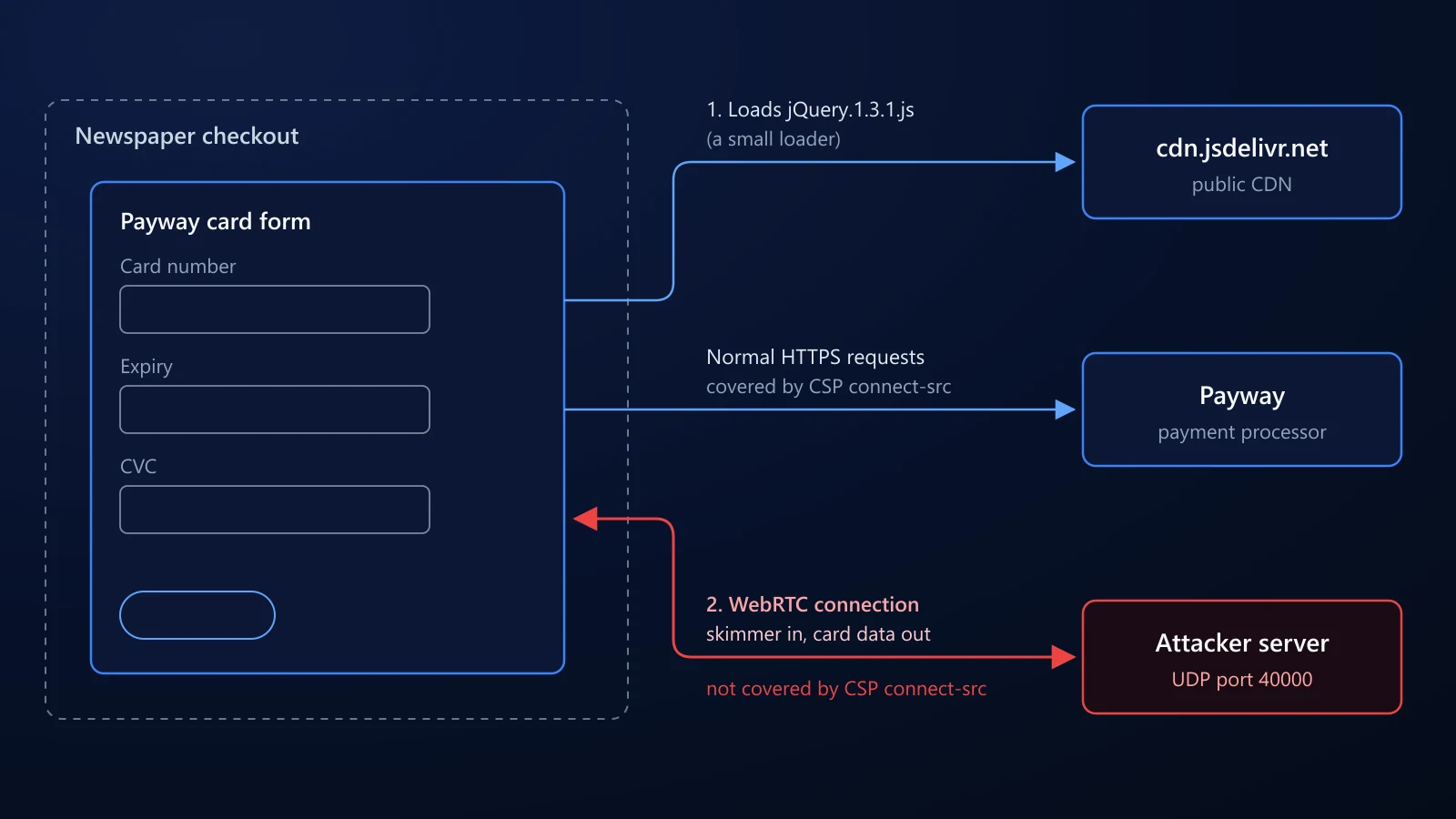
According to Guardio's analysis:
- The added line loaded a file named
jQuery.1.3.1.js, copying the name of a 2009 jQuery release, from a GitHub repository served through the public jsDelivr CDN:cdn.jsdelivr.net/gh/fs82g9omml/alianet@main/jQuery.1.3.1.js. - That file was only a loader, about 12 KB, dressed up as a "chat SDK". It held no card-stealing code, so a scanner that downloaded it found nothing obvious.
- About five seconds after the form loaded, the loader opened a WebRTC connection to
89.116.171.109on UDP port 40000. The server sent back the actual skimmer, which then ran inside the form. It was delivered to each visitor individually and never stored as a file. - The skimmer ran only on pages with a card number field, including saved-card update pages. It read the card number, expiry date and security code, plus name, email, phone and address when the form asked for them, and sent them over the same connection when the buyer hovered over the pay button, before any click.
Guardio counted 102,749 downloads of the loader between 13 and 19 November, about 13,700 to 18,700 a day, and stresses that a download means a browser opened the form, not a stolen card. The file did not exist before 09:51 UTC on 13 November. Guardio says it shared its findings with Payway, Naviga and the publishers; we found no public statement from Payway or Naviga when we checked.
Not the first WebRTC skimmer
WebRTC exfiltration is new to the news, not to researchers. In March 2026, Sansec reported the first skimmer it had seen using WebRTC, on online stores, including the store of a car maker worth more than 100 billion dollars, and wrote that "WebRTC peer connections operate outside the scope of Content Security Policy." Guardio found no shared server, account or code between the two and does not claim a link. PaperCut shows the technique moving from single stores to a supplier that serves dozens of brands at once.
How a WebRTC skimmer bypasses CSP
Three things lined up in the attacker's favour.
The theft used a channel CSP does not cover. A CSP's connect-src directive lists the servers a page may contact with fetch, XHR, WebSocket and similar web requests. A WebRTC connection (RTCPeerConnection) is not one of them. A checkout with a tight connect-src would still let PaperCut's connection through, and would send no violation report about it. The CSP draft does define a webrtc directive for this channel, but no browser has shipped it yet: Chrome does not implement it and logs it as an unrecognized directive.
The traffic was not web traffic. WebRTC data travels as encrypted UDP straight to an IP address. Tools that inspect HTTP requests, in the browser or on the network, see no request to flag, only encrypted packets to an unknown address.
The file looked clean and the code lived elsewhere. Scanners that download a page's scripts and compare them saw a small "chat SDK" loader on a well-known CDN. The skimmer itself never existed as a file they could fetch.
There is also a point about who controls what. The skimmer ran inside Payway's card form, which is a separate page embedded in the newspaper's checkout. The newspaper's own CSP and monitoring do not reach inside it: only the headers the form's host sends apply there. That is also how PCI DSS 6.4.3 splits responsibility for hosted payment forms: the scripts inside them belong to the provider.
The table below reads from the side of whoever serves the card form.
| Control | Would it have stopped or seen PaperCut? |
|---|---|
CSP connect-src | No. WebRTC is not covered, so nothing is blocked or reported |
| Network or HTTP inspection | Hard. No HTTP request, only encrypted UDP to an IP |
| Scanner that downloads scripts | No. It finds the loader, not the skimmer |
CSP script-src allowing all of cdn.jsdelivr.net | No. Any file on that CDN is allowed |
| Connection-Allowlist with WebRTC blocked | Yes, in Chrome 152 and later. The WebRTC connection is blocked and reported |
| Script inventory on the payment page | Yes, as a signal. A new script from jsDelivr appears and waits for review |
Am I affected? Was my card stolen?
As a reader: if you entered a card on the subscription or card update page of an affected newspaper between 13 and 19 November 2026, assume the card is compromised. Guardio's article has the full list of papers in its appendix.
As a business using Payway's hosted form or Naviga's checkout: Guardio advises searching your hosted payment forms for the jsDelivr path containing fs82g9omml, checking for WebRTC traffic to the two addresses below, finding who edited the form template on 13 November, and checking other templates for the same change. Publishers should identify customers who entered cards in that window, because breach notification rules may apply. Feroot advises any organisation that took cards through an affected form in that window to talk to counsel about card-breach notification.
As anyone running a checkout: PaperCut needs no vulnerability in your code. It needs one added line in a form your checkout trusts, and a page that allows WebRTC. Check both. For a quick outside look at what a public page uses, the free Technology Checker lists the technologies and library versions it reveals. To see what actually runs in buyers' browsers, you need the browser reports described below.
Indicators of compromise
From Guardio's report:
| Indicator | Value |
|---|---|
| Loader URL | cdn.jsdelivr.net/gh/fs82g9omml/alianet@main/jQuery.1.3.1.js |
| GitHub account | fs82g9omml |
| WebRTC server | 89.116.171.109, UDP 40000 |
| WebRTC server, earlier build | 89.117.134.66, UDP 40000 |
| Affected form | paywayws.net and paywayws.com, path /PaywayWSHosted/HostedFormLoad.jsp |
| Active | 13 November 2026, 09:51 UTC, to 19 November 2026 |
Guardio also publishes file hashes for the loader builds and for the skimmer delivered over WebRTC.
How to stop a WebRTC skimmer on a payment page
These measures apply to whoever serves the card form: the payment provider for a hosted form, or you when the card fields sit on your own page. If your card form is hosted by a provider, these are the questions to ask that provider.
Block WebRTC on payment pages with a Connection-Allowlist
The Connection-Allowlist header lists every destination a page may connect to, and the browser blocks the rest, across fetch, WebSocket, navigation, redirects and WebRTC. WebRTC is blocked by default and only allowed with an explicit webrtc=allow. A card form has no reason to make video calls, so a list without that option would have stopped PaperCut's connection, and sent a connection-allowlist report for it:
Reporting-Endpoints: centralcsp="https://<Endpoint-ID>.report.centralcsp.com"
Connection-Allowlist-Report-Only: (response-origin "https://api.payments.example"); report-to=centralcsp
The header is enforced in Chrome from version 152, after an origin trial. Firefox and Safari do not implement it, so keep a strict CSP for every browser and add the allowlist as a second layer. Start in report-only mode, watch the reports for at least a week, then switch to the enforcing Connection-Allowlist header.
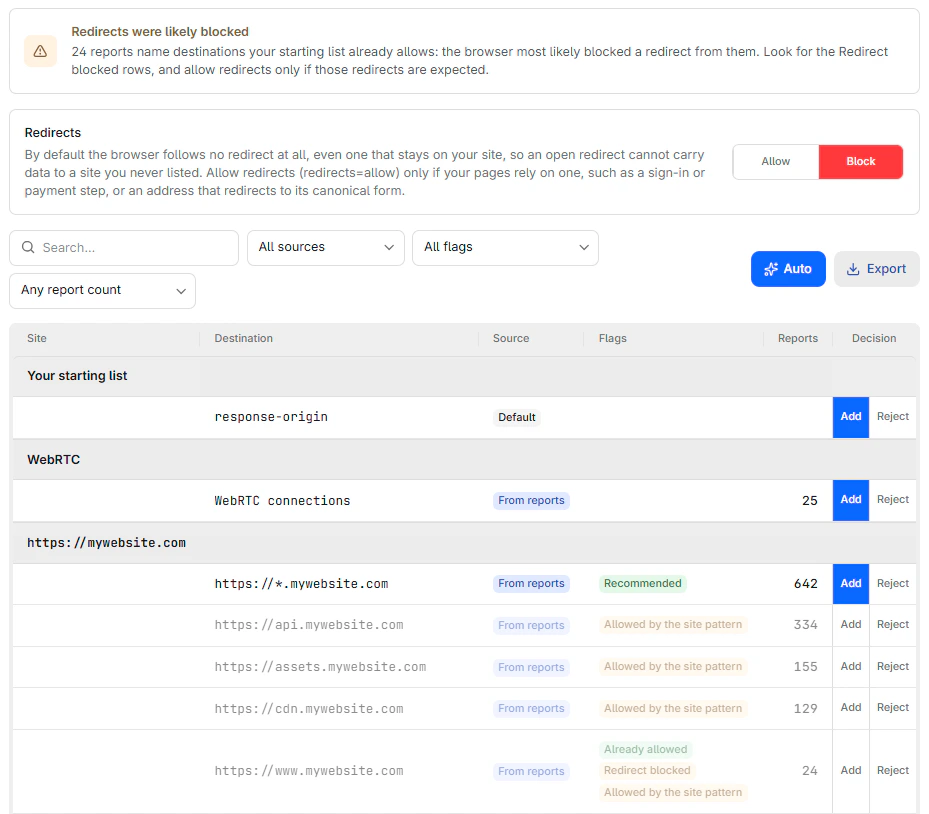
The Connection-Allowlist builder turns those reports into a list. It groups every reported WebRTC connection into a single WebRTC connections row, and its guidance is plain: reject it unless your pages make video or voice calls. On a payment page, that row is the PaperCut channel.
Do not trust a whole public CDN in script-src
jsDelivr serves files from any public GitHub repository, with URLs of the form cdn.jsdelivr.net/gh/user/repo@version/file (jsDelivr). A CSP that allows https://cdn.jsdelivr.net in script-src therefore allows every public GitHub repository, including fs82g9omml/alianet. We do not know whether Payway's form sent a CSP; the point holds for any checkout that does.
The same applies to other public CDNs. On a payment page, prefer scripts served from your own origin, or a nonce-based policy with 'strict-dynamic', over a host list. How to build a strong CSP and the JSONP bypass explain why host allowlists are weak.
Flag every new script on the payment page
The added line had to load something new: a script from a new URL. A script inventory built from the browser's 'report-sha256' hash reports lists every script that ran on the payment page in real sessions, so a new jQuery.1.3.1.js from jsDelivr shows up the first day it runs. For each script reported that way, the CentralCSP engine also identifies the technology, its version, its lifecycle status and its known CVEs. That is the job PCI DSS 6.4.3 (authorize and justify every payment page script) and PCI DSS 11.6.1 (detect and alert on unauthorized changes) describe.
In CentralCSP, each new or changed script on a payment page waits in review until a person approves it with a written justification, rejects it with a reason, or puts it out of scope. The New script to review alert can reach Slack, Microsoft Teams, Google Chat, Telegram, email or a webhook the moment one appears.
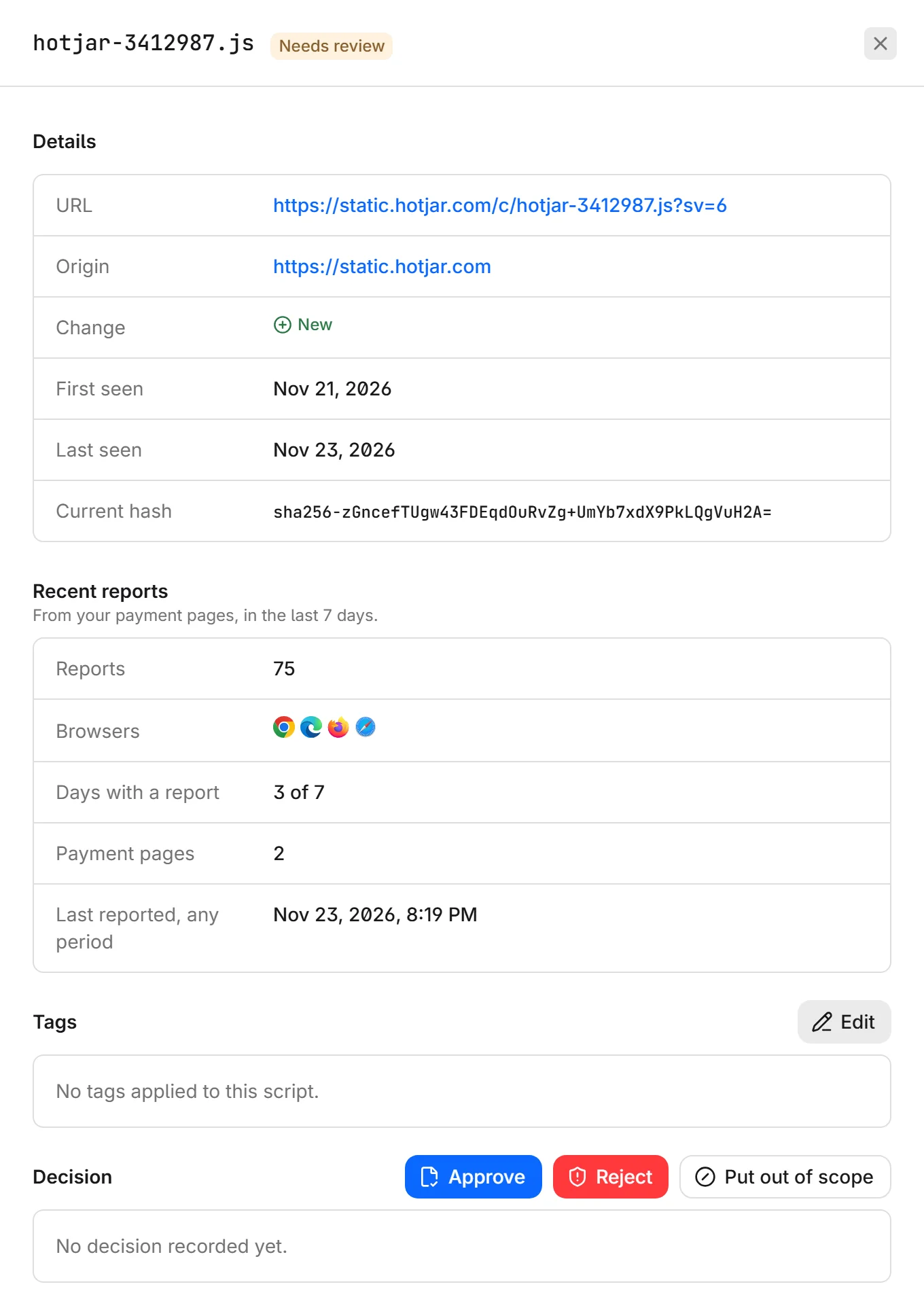
The inventory is a detection signal, not a block. It tells a person that the payment page changed, so the loader can be pulled before it runs for six days. The Connection-Allowlist is what stops the data from leaving while someone looks. Together, CSP reporting, a script inventory and an egress allowlist cover the three gaps PaperCut used, which is what client-side security on a payment page comes down to.
To see this on your own checkout, start free with CentralCSP: add 'report-sha256' and a Connection-Allowlist-Report-Only header to the payment page, and the first week of reports lists every script it runs and every WebRTC connection it opens.
Other checkout supply chain attacks this autumn
PaperCut is one of several checkout attacks in a few weeks, each through code the site trusted:
- Fandango, 8 to 11 October: a skimmer on the official checkout page captured card numbers, CVVs and expiry dates, the company told customers (BleepingComputer).
- Checkiout, Shopify apps, 9 to 20 October: scripts hidden in the settings of review, swatch and other apps sent shoppers at 71 stores to a fake checkout (Sansec).
- Convertr and Plausible, between 24 and 27 October: a skimmer added to the analytics tracker of a Brazilian e-commerce platform ran on dozens of fashion checkouts (Sansec).
- OPTIMJACK, 16 November: malicious code in Optimizely Web Experimentation snippets reached the sites of 178 organisations, according to Report URI (our write-up, and which CSP settings stopped it).
For the longer history, from British Airways to Ticketmaster and polyfill.io, see what Magecart and formjacking are.
FAQ
What is the PaperCut skimmer?
PaperCut is the name Guardio Labs gave to a card skimmer found on the subscription checkouts of about 80 US newspapers in November 2026. It was loaded by one line added to the Payway card form those checkouts share, and it sent stolen cards over WebRTC.
Which newspapers were affected?
Guardio names the Boston Herald, Denver Post, Orange County Register, Mercury News, Sacramento Bee, Charlotte Observer, Newsday, New York Daily News, Orlando Sentinel and Sun Sentinel, and lists the rest in its report's appendix.
What is a WebRTC skimmer?
A skimmer that uses WebRTC, the browser technology for video and voice calls, to download its code and send stolen data. It makes no ordinary web request, so a CSP connect-src and tools that watch HTTP traffic do not see it.
Does a Content Security Policy stop a WebRTC skimmer?
Not on its own. connect-src does not cover WebRTC connections. A strict script-src can stop the loader from running in the first place, but not if the policy allows the CDN it comes from. To block the WebRTC channel itself, use a Connection-Allowlist without webrtc=allow, enforced from Chrome 152.
Is PaperCut a Magecart attack?
In the broad sense the industry uses, yes: Magecart is the umbrella name for skimmers injected into checkout pages. What sets PaperCut apart is the delivery, through a payment form shared by dozens of sites, and the WebRTC exit. For the general detection guide, see Magecart and formjacking.
Is jsDelivr unsafe?
No. jsDelivr did what it is built to do: serve files from public repositories. The risk is allowing an entire public CDN in a payment page's policy, since that allows files from anyone.
I paid with Apple Pay or PayPal. Was my card stolen?
According to Guardio, Apple Pay, Google Pay and PayPal payments did not pass through the affected form. If you typed a card into the form, including to update the card saved on your account, treat it as stolen.
Related
- Connection Allowlists, a network egress sandbox in the browser
- What Magecart is, and how to detect a formjacking skimmer
- OPTIMJACK, the Optimizely supply chain attack
- Build a script inventory with CSP hash reporting
- PCI DSS 6.4.3: managing payment page scripts
- PCI DSS 11.6.1: detecting script and header changes on payment pages
- Would CSP and PCI DSS have stopped the Optimizely attack?
Sources
- Guardio Labs, PaperCut: 80 US newspaper websites served a credit card stealer, 22 November 2026
- Feroot, PaperCut newspaper card skimmer
- Sansec, WebRTC skimmer, 24 March 2026
- jsDelivr, GitHub endpoint documentation
- WICG, Connection Allowlists
- BleepingComputer, Fandango says hackers stole payment card details from checkout pages
- Sansec, Checkiout: Shopify app supply chain attack
- Sansec, Convertr and Plausible supply chain attack