OPTIMJACK, the Optimizely supply chain attack

CentralCSP Team
CentralCSP ·
Last update:
On 16 November 2026, an attacker took control of the JavaScript that Optimizely, a popular A/B testing service, delivers to its customers' websites. For most of a day, sites such as the BBC, CNN, Zoom and HSBC were seen serving the attacker's code to their visitors from Optimizely's own servers. The code swapped cryptocurrency wallet addresses, grabbed screenshots and cookies, skimmed card numbers typed into forms on the page and tried to hack older iPhones. Optimizely fixed the flaw the same afternoon and removed the code that night. The campaign is called OPTIMJACK, and the flaw is tracked as CVE-2026-132224.
In short, depending on who you are:
- You use Optimizely Web Experimentation: check your project history for 16 November and search your custom code for the indicators below, even if you were not contacted. According to Optimizely, you do not need a new snippet or a password reset.
- You use Feature Experimentation, the SDKs or legacy Full Stack: Optimizely says these were not affected.
- You visited an affected site on 16 November: if you sent crypto by copying an address, or typed a card number into a form on the page, read what visitors should do.
- You run any website with third-party scripts: this is a textbook case of why a trusted script needs watching. The CSP and PCI DSS lessons are in a separate post.
What Optimizely Web Experimentation does, and why it was the way in
Optimizely Web Experimentation lets marketing and product teams change a web page for some visitors (a new headline, a different button) and measure which version performs better. To do that, every page carries a small Optimizely script, the snippet, loaded from cdn.optimizely.com. Each customer can also add its own JavaScript to the snippet through a field called Project JavaScript, and that code runs on every page load.
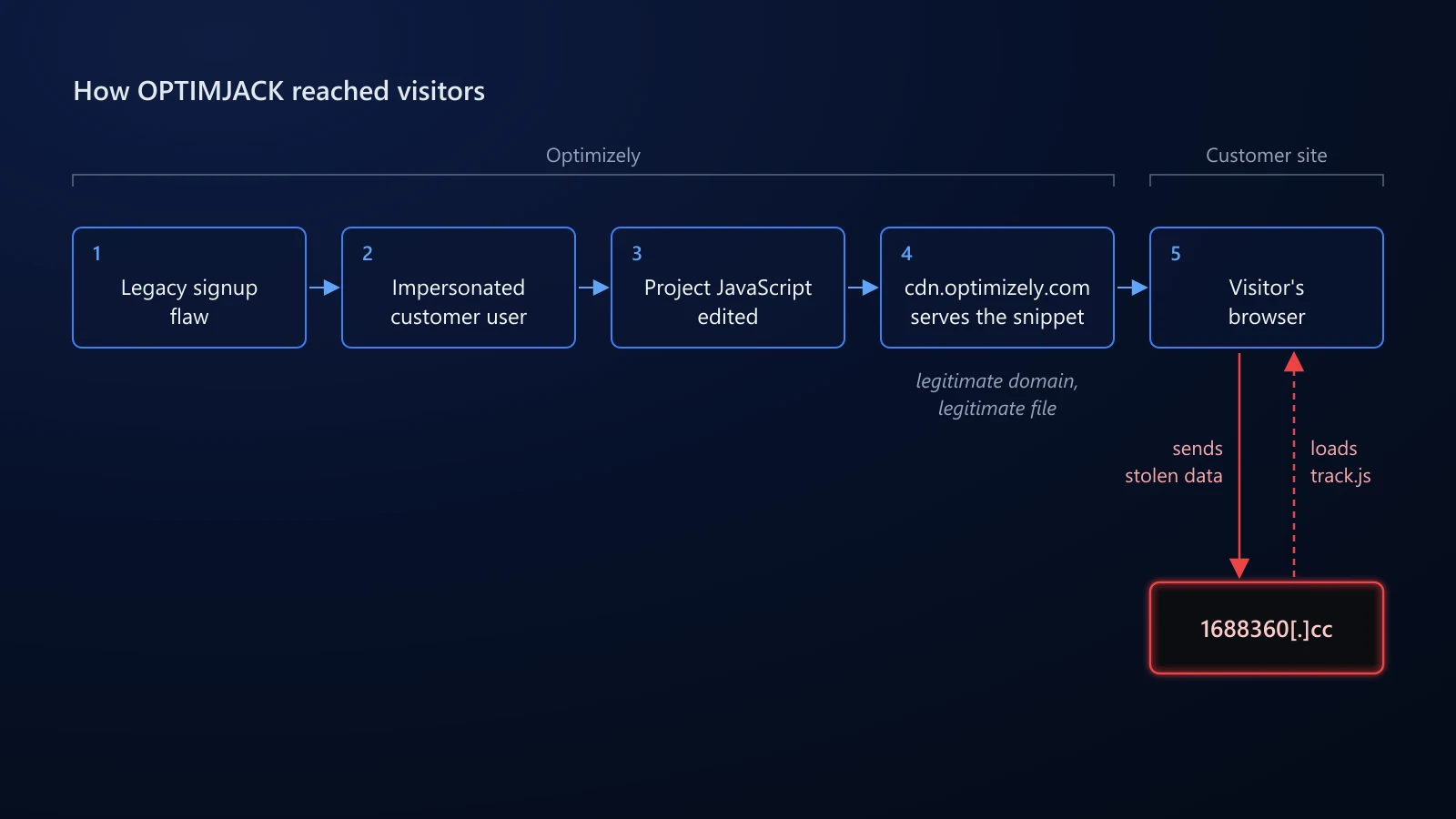
That is the field the attacker wrote into. Nothing was wrong with Optimizely's content delivery network (CDN): as StepSecurity reports, quoting the researcher who found the attack, "the CDN served exactly what it was given." Browsers loaded a legitimate file from a legitimate domain, and that file now contained malware. This is what a supply chain attack means on the web: the attacker never touches your site, they change something your site trusts.
How Optimizely was hacked: CVE-2026-132224
According to Optimizely's write-up of 25 November, the attacker used a flaw in a legacy free-trial signup flow, now shut down. They created trial accounts, then used brute force, guided by public information, to find the email addresses of real users at customer companies, and impersonated them. Posing as those users, they edited Project JavaScript in customer projects and even reopened some archived ones.
Optimizely's status page states that "this was not a credentials breach", and its 25 November write-up adds that no Optimizely administrator account was compromised and no passwords or credentials were stolen. MITRE published CVE-2026-132224 on 18 November, and CISA added it to its Known Exploited Vulnerabilities catalog on 24 November.
| CVE | CVE-2026-132224 |
| Product | Optimizely Web Experimentation (a hosted service) |
| Weakness | External control of critical state data in the account signup flow (CWE-642) |
| Severity | 7.1, High (CVSS 4.0, scored by MITRE, the CNA that published the record) |
| Affected | Web Experimentation before 17 November 2026 |
| Not affected | Feature Experimentation, SDKs, legacy Full Stack |
| Fixed | 16 November 2026, 16:10 UTC, on Optimizely's side. Nothing to install |
| Exploited | Yes. In the CISA KEV catalog since 24 November 2026 |
Because it is a hosted service, there is no version to upgrade. The fix happened on Optimizely's servers; what remains for customers is to confirm their projects are clean.
What happened, hour by hour
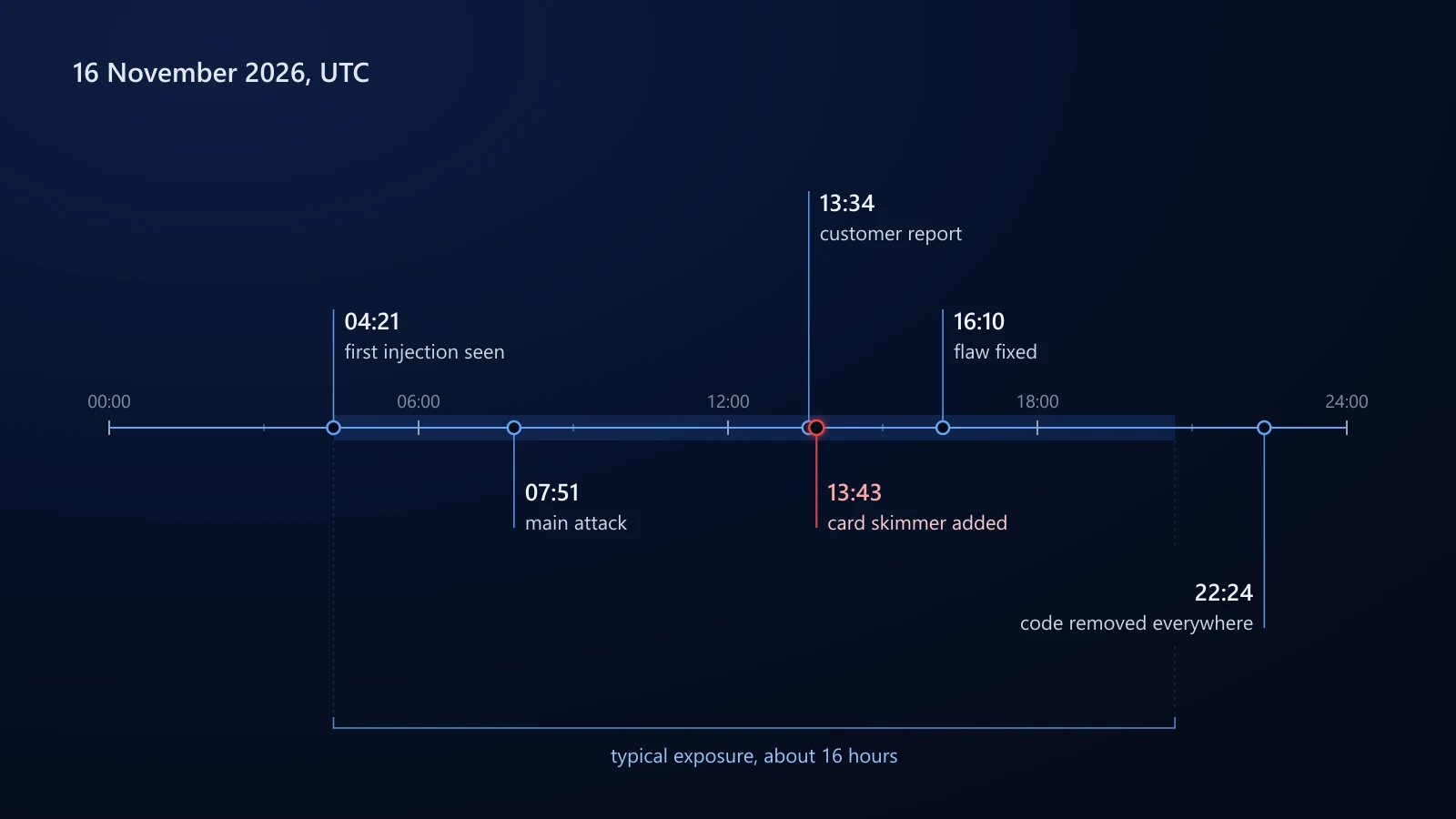
Two timelines exist: Optimizely's, from its own logs, and that of the researchers at Report URI who found the attack, from the snippets they collected and checked from the outside ("Researchers" in the table). They agree, with one difference: Optimizely places early test code from 01:20 UTC and the main attack at 07:51 UTC, while the researchers first saw injected code at 04:21 UTC. All times are UTC.
| When | What happened | Source |
|---|---|---|
| 13 Nov, 18:40 | The attacker creates test accounts that look like normal signups | Optimizely |
| 16 Nov, 00:37 | The attacker starts probing the signup flaw | Optimizely |
| 01:20 | Early test code lands in a few projects, including one production project at 03:54 | Optimizely |
| 04:21 | First injection seen, on the BBC snippet, loading webshell[.]lol | Researchers |
| 07:51 | The main attack begins and spreads across many customer projects | Optimizely |
| 08:28 | 1688360[.]cc/track.js first seen, on bbc.com | Researchers |
| 13:34 | A customer reports a malicious script. This is how Optimizely finds out | Optimizely |
| 13:43 | The card skimming version appears | Both |
| 16:06 to 16:52 | Blocking starts at 16:06, the flaw is fixed at 16:10, the last attacker session ends at 16:52 | Optimizely |
| 19:24 to 19:59 | A sweep finds 186 of 1,611 snippets infected (188 in the final count) | Researchers |
| 20:40 to 21:10 | Mass cleanup across affected sites | Researchers |
| 22:24 | Malicious code removed from every affected project | Optimizely |
| 23:11 | Every infected file the researchers tracked is clean | Researchers |
| 17 Nov, 00:01 | First notice sent to affected customers | Optimizely |
| 17 Nov, 00:37 | 1688360[.]cc placed on hold (clientHold) | Researchers |
For most sites, the exposure window was about 16 hours, according to StepSecurity.
What the malware did: crypto clipper, card skimmer, iPhone exploits
The loader in Project JavaScript came in three forms, according to the researchers: a plain <script> tag pointing to 1688360[.]cc/track.js; the same address encoded in base64 and decoded with atob(), so a search for the domain finds nothing; and a full inline copy run with eval when the domain was blocked. The payload it loaded (about 30 KB once decoded, according to StepSecurity) was rebuilt 26 times during the day and carried four modules at once:
- Crypto clipper. It found wallet addresses on the page (Bitcoin, Ethereum and other EVM chains, TRON, Solana, TON, Litecoin, Bitcoin Cash, Dogecoin) and replaced them with the attacker's, in page text, forms, links, the clipboard and outgoing requests. Someone copying a deposit address got the attacker's instead.
- Screenshots and cookies. When it swapped an address next to wallet or payment wording, it sent the page URL, a screenshot and the cookies scripts can read to
1688360[.]cc/hit.php. Cookies marked HttpOnly were out of reach. - Card skimmer, from 13:43 UTC. This is the Magecart part of the attack, also called formjacking. It watched form submissions and outgoing requests for a valid card number, expiry date and CVV, and sent them to
1688360[.]cc/card.php. Cards typed into payment fields hosted by a provider in an iframe, such as Stripe or Adyen, could not be read. - iOS exploit kits. On iPhones and iPads it loaded a hidden frame from
.icudomains serving one exploit chain per generation of iOS: the known Coruna kit for iOS 13 to 17, the known DarkSword kit for iOS 18.x, and, according to the researchers, a separate chain for iOS 26 that only fingerprinted the device. Optimizely says it targeted iOS and iPadOS 18.7 and earlier, and that it has had no reports of infected devices.
The researchers counted about $7,040 received by the attacker's wallets by 19:25 UTC on 16 November, and BleepingComputer notes that some of these wallets were active before the attack. Alex Thorn of Galaxy Digital, cited by StepSecurity, estimates that victims sent about $2,300 in total and that most of the Bitcoin looks like the attacker's own funds; StepSecurity could not confirm this. Nobody has published how many cards or cookies were taken, and Optimizely says it cannot see what was captured in visitors' browsers.
Which sites were affected
The researchers checked 1,611 Optimizely snippets they knew of and found 188 infected, belonging to 178 organisations, with banking and finance (32), technology and SaaS (23) and retail (20) at the top. Zscaler ThreatLabz counted more than 450 domains and 3,000 URLs serving the script. Optimizely's status page says fewer than 5% of its customers were affected, without an absolute number.
Sites named by the researchers and BleepingComputer as loading or trying to load the code include Zoom, the BBC, CNN, Fox News, Salesforce, GitLab, IKEA, HSBC, Equifax, Air France-KLM, Ledger, Peacock, Smartsheet, Mutual of Omaha, Change.org, Bitly, UNICEF USA and Optimizely itself. Being on this list means the code reached the site's pages, not that any visitor data is confirmed stolen. Salesforce said it disabled Optimizely scripts across its instances as a precaution.
The researchers also link the attack to an earlier wave from 13 to 16 November, where the same webshell[.]lol injector arrived through Kissmetrics, StorifyMe and Minute Media scripts.
Optimizely's own snippets for www.optimizely.com and login.optimizely.com carried the code too. Few victims had a defence in place: the researchers crawled 256 hosts of affected organisations and, counting by organisation, found only 24 of 159 whose Content Security Policy (CSP, the header that tells browsers which scripts a page may load and where it may send data) was strict enough to block the payload. Why so few, and which policy would have held, is covered in the CSP and PCI DSS deep dive.
Am I affected by the Optimizely hack?
I am an Optimizely customer
Optimizely contacted every Web Experimentation customer directly, and your customer success manager can give you the exact exposure times for your projects. Then follow Optimizely's recommendations:
- Check project history for changes during the attack window, including archived projects that were reopened. Optimizely says that if nothing changed in that window, you were not affected.
- Search Project JavaScript, experiment code, shared code and extensions for the indicators below, and for any
atob(,eval(or<script>you did not write. - Review users, invitations, API tokens and webhooks. Look for invitations to unknown domains and
+taglookalikes of colleagues' addresses, revoke tokens nobody can account for, require SSO and MFA, and limit who can edit code. - Check snippets you no longer use. If a page still loads the snippet of a project you abandoned, that snippet could have served the code: send its project ID to Optimizely.
- Keep the snippet off payment and login pages unless you test there, and use your payment provider's hosted fields.
- Add a CSP in report-only mode, then enforce it with only the Optimizely sources you use. The CSP builder drafts that policy from your own reports.
If card or login pages loaded the snippet on 16 November, involve your security and compliance teams: card data typed into forms on the page after 13:43 UTC was exposed.
Optimizely's PCI mode, which serves the snippet from a separate host (cdn-pci.optimizely.com) for payment pages, did not help: the attacker's change went out through the PCI host too.
I visited an affected site
You cannot easily tell after the fact whether a page you opened ran the code. If you visited one of the sites above on 16 November, from the early hours (the first code reached a production project at 03:54 UTC) until about 23:00 UTC, when the last infected copies were cleaned:
- Crypto: check any transfer you made by copying an address. In future, verify the receiving address on your hardware wallet screen.
- Cards: StepSecurity advises treating a card typed on an affected site in that window as exposed. Watch your statements and ask your bank for a new card if in doubt. Cards entered in a payment provider's embedded form were not readable.
- iPhone and iPad: update to the latest iOS or iPadOS. The researchers note the kits' own comments treat iOS 18.7.3 and later, and 26.3 and later, as patched.
Indicators of compromise (IoCs)
Domains are written with [.] so they cannot be clicked. Block them including subdomains, and search your logs, proxy data and CSP reports from 16 November onward.
| Indicator | Role |
|---|---|
1688360[.]cc | Main server: /track.js, /card.php, /hit.php, /html2canvas.min.js |
webshell[.]lol | Injector script get.js, used in the earlier wave and in the first Optimizely injection (BBC snippet) |
linkforge[.]cc | SEO-panel script that carried the injector before the Optimizely attack |
5vobauua3ojpklx[.]icu, eil786npto9u5bq[.]icu | iOS stage loader boot.js and exploit pages |
l7bcsnwc7nzr3uo[.]icu | Exploit kit telemetry |
ios-hack[.]icu, q1ls1ho9x7wsxlu[.]icu, je4ft3gn8vxudum[.]icu | Fallback servers hard-coded in boot.js |
136.113.106.136, 34.96.213.201, 34.87.36.58 | IP addresses of 1688360[.]cc, 5vobauua3ojpklx[.]icu and eil786npto9u5bq[.]icu |
window._k7, window.__k7b, data-channel-code="02111110" | Traces left in the page |
As StepSecurity warns, blocking the domain is not enough because of the inline eval fallback: the code has to come out of the project. And since the payload changed 26 times, match on domains and behaviour rather than on a single file hash. Full lists with wallet addresses and hashes are in the researchers', StepSecurity's and Zscaler's write-ups.
What Optimizely changed
According to its 25 November update, Optimizely has:
- fixed the flaw, permanently disabled the legacy signup flow behind it and removed the impersonation feature;
- restored affected projects to their last clean versions and re-archived the reopened ones;
- added Content Security Policies to its login, home and Admin Center pages, with the login page now enforcing its policy;
- brought in Mandiant for the investigation, with a final report expected in the coming weeks.
It also plans a second-person approval for changes to Project JavaScript and other custom code, native alerts for changes to code, users, tokens and webhooks, and a review of sign-in, sessions, permissions and tokens against OWASP ASVS 5.0 Level 2. Until those alerts exist, it asks customers to check project history every week.
The status page marked the incident resolved on 27 November, though the investigation continues.
The lesson for every site: watch trusted third-party scripts
Nobody at the BBC, Zoom or HSBC deployed anything on 16 November. The script on their pages had the same name, came from the same trusted domain and passed every check that looks only at where code comes from. What changed was its content and where it sent data. A trusted third-party script can change under you at any time, and the review you did when you added it says nothing about what it does today. That blind spot, the code that runs in your visitors' browsers rather than on your servers, is what client-side security covers.
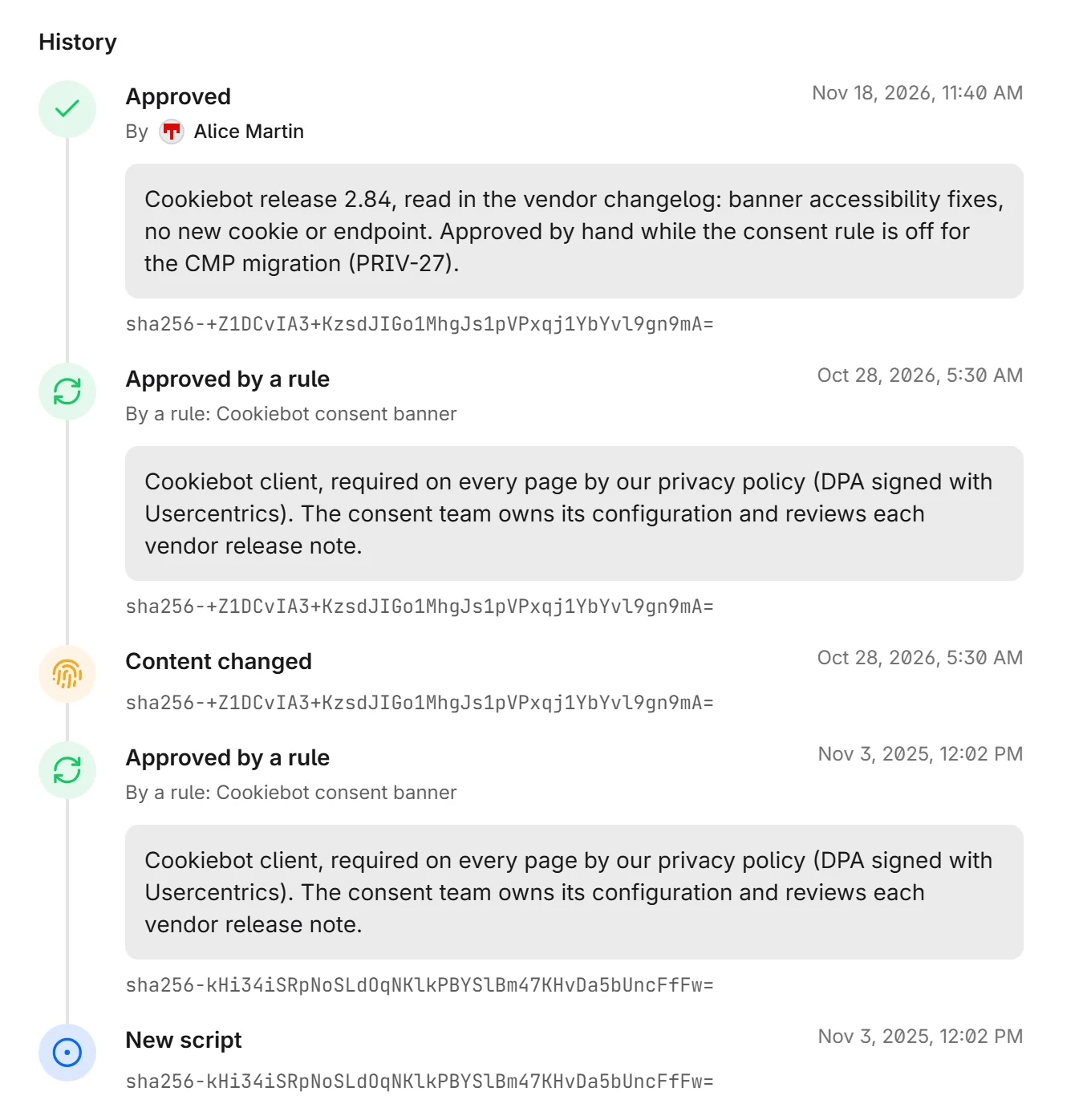
So the signal to watch is in the browser: a known script whose content changes outside your own publishing, and a new destination like 1688360[.]cc appearing in your pages' traffic. With CSP reporting in place, CentralCSP collects the CSP violation reports that name those new destinations, keeps a script inventory of every script browsers run with its hash history, and sends a New script origin alert when a new party starts executing code on your pages, or a Changed script to review on payment pages alert for PCI DSS. Optimizely snippets change each time a team publishes an experiment, so the useful question is not "did it change?" but "did it change when we did not publish, and does it now talk to a host we have never seen?". The supply chain monitoring page shows how these pieces fit together.
For what a strict CSP would and would not have stopped, why Subresource Integrity cannot pin an Optimizely snippet, and what OPTIMJACK means for PCI DSS 6.4.3 and 11.6.1, read the Optimizely attack through CSP and PCI DSS. To see your own scripts and their destinations, start free with CentralCSP.
FAQ
What is OPTIMJACK?
OPTIMJACK is the name given to the 16 November 2026 campaign in which an attacker wrote malicious JavaScript into the Optimizely Web Experimentation projects of at least 178 organisations. StepSecurity credits the name to a write-up by Amirul Cyber. The name does not come from Optimizely.
Was Optimizely hacked?
An attacker exploited a flaw in Optimizely's legacy signup flow, tracked as CVE-2026-132224, to impersonate users at customer accounts and edit their code. Optimizely says no administrator account was compromised, no passwords were stolen and its investigation has found no evidence that data it holds was exfiltrated.
What is 1688360.cc?
It is the main server the attacker used. Injected snippets loaded track.js from it, and the payload sent stolen card data, screenshots and cookies back to it. The domain was placed on hold (clientHold) early on 17 November.
Which sites were affected by the Optimizely attack?
The researchers who found the attack saw the code in 188 snippets belonging to 178 organisations, including the BBC, CNN, Zoom, Salesforce, HSBC and IKEA, and Zscaler counted more than 450 domains. Being listed means the code reached the site's pages, not that any visitor data is confirmed stolen.
Was Optimizely Feature Experimentation affected?
No. Optimizely says only Web Experimentation was affected, not Feature Experimentation, its SDKs or legacy Full Stack.
Is Optimizely safe to use now?
The flaw was fixed on 16 November and the code removed the same day. Optimizely is also adding a second approver and change alerts for custom code. The broader risk remains for any tag that can run code on your pages: limit who can edit it, keep it off payment and login pages, and monitor what it loads.
Were card details stolen?
The skimmer was live from 13:43 UTC on 16 November and could read cards typed into forms on the page. No one has published how many cards were captured, and Optimizely says it cannot see that. Cards entered in a payment provider's iframe, such as Stripe or Adyen, were not readable.
Related
- The Optimizely attack through CSP and PCI DSS
- Magecart and formjacking: how to detect a skimmer
- PaperCut: the WebRTC card skimmer on 80 US newspapers
- How attackers abuse Google Tag Manager, and how a strict CSP contains it
- Build a script inventory with CSP hash reporting
- PCI DSS 6.4.3: managing payment page scripts
- PCI DSS 11.6.1: detecting script and header changes on payment pages
Sources
- Optimizely, Web Experimentation security incident update, 25 November 2026
- Optimizely status page, Web Experimentation Security Incident
- CVE-2026-132224, CVE record
- CISA, Known Exploited Vulnerabilities catalog (CVE-2026-132224 added 24 November 2026)
- StepSecurity, OPTIMJACK: Optimizely-hosted scripts, crypto clipper and card skimmer
- Zscaler ThreatLabz, Attackers exploit Optimizely flaw to inject malicious JavaScript
- BleepingComputer, Optimizely supply chain attack delivers malware to CNN, Fox News, BBC, Salesforce sites