

Rules
Pick an event, pick channels, set a cooldown. The sixteen events available, how to tune a spike rule, and how to set the technology rules.
Last update:
A rule watches one event and notifies one or more channels when it fires.
Adding a rule requires the website Manager role, and at least one channel.
Add a rule
Alerts > Configuration > Add rule.
| Field | Notes |
|---|---|
| Name | What the notification is called |
| Event | Grouped by surface. Cannot be changed after creation |
| Channels | One or more, up to 20. Required |
| Cooldown (minutes) | Default 15. Minimum time between notifications |
| Spike multiplier | Spike events only. Default 3 |
| Minimum reports per hour | Spike events only. Default 50 |
| Minimum severity | New vulnerability only. Default Medium |
| Statuses | Outdated or deprecated version only. Both selected by default |
To change which event a rule watches, create a new rule and delete the old one.
A spike event adds the multiplier and the floor to the dialog:
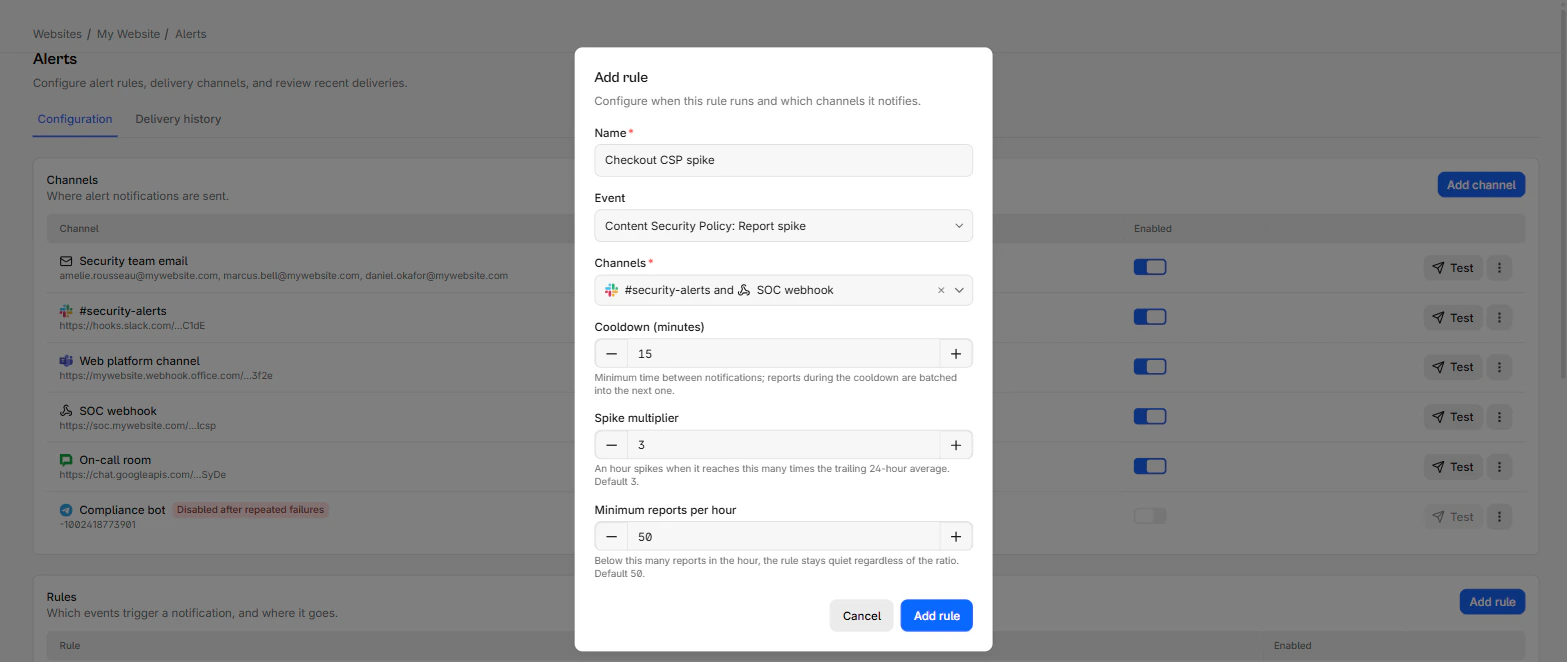
The 16 events
The events are grouped by the surface they watch:
| Surface | Events |
|---|---|
| Content Security Policy | New violation type, Report spike |
| Script hashes | New script origin |
| Subresource Integrity | Report spike |
| PCI compliance | Unjustified script on payment pages |
| Technologies | New vulnerability, Outdated or deprecated version |
| Network errors | New failing origin, Report spike |
| Crashes | Report spike |
| COOP | New violation type |
| COEP | New violation type |
| Permissions Policy | New violation |
| Connection allowlist | New blocked origin |
| Deprecations | New deprecated API usage |
| Interventions | New browser intervention |
"New" events fire the first time something is observed. Because reports are kept for 90 days, something that goes quiet for a quarter and returns is treated as new again.
The two Technologies events read the Technologies inventory rather than raw reports, so they need a plan that includes it. Refer to Tune a technology rule.
Cooldown
Cooldown is the minimum gap between notifications for a rule, entered in minutes and defaulting to 15.
It does not drop anything. Findings during the cooldown are batched into the next notification, so a burst produces one grouped message rather than 50.
Set it against how you consume alerts. 15 minutes suits a chat channel. For a rule that pages someone, set a longer cooldown. The maximum is 24 hours. A value above 1,440 minutes is rejected.
Tune a spike rule
Spike rules compare the last completed hour against the average of the previous 24 hours. Two settings control them, and both matter.
Spike multiplier is how many times the trailing average the hour must reach. Default 3, range 1.5 to 100.
Minimum reports per hour is a floor. Below it the rule stays quiet no matter the ratio. Default 50, range 1 to 1,000,000.
The floor is what stops the false alarms
On a low-volume site the multiplier alone is useless: going from two reports an hour to eight is a 4x spike and means nothing. The floor is what makes spike rules usable. Set it above your normal hourly volume, not below it.
Leaving both at their defaults stores no configuration at all, so the rule follows any future change to the defaults. Setting them explicitly pins your values.
Wait until you know a site's normal volume before adding spike rules. Created on day one, the 24-hour baseline is still forming and the rule fires on the ramp-up.
Tune a technology rule
The two Technologies events watch the library inventory built from hash reports. Both fire on a change to the inventory, never on what was already there when the rule was created, so review the current inventory first. Refer to Get started with Technologies.
New vulnerability fires when an advisory is published for a library version already on the site, and when a version with a known vulnerability is detected for the first time. The one setting is Minimum severity: findings below it stay quiet. The default is Medium. Set it to High or Critical for a channel that pages someone, and leave it at Medium for a chat channel. Low includes advisories with a Low band; advisories with no severity assigned never fire.
The notification names the library and version and lists the CVE IDs, so the reader can go straight to the advisory.
Outdated or deprecated version fires when a technology is detected with, or moves to, one of the selected statuses. Two switches, Outdated and Deprecated, are both on by default and at least one must stay on. A Deprecated-only rule is the low-noise option: it fires rarely and each finding calls for a replacement rather than an upgrade.
Both rules batch like every other rule, so a deployment that brings in several outdated libraries produces one grouped message after the cooldown.
A rule set that works
For most sites, four rules:
| Event | Channel | Cooldown |
|---|---|---|
| CSP, New violation type | Chat | 15 min |
| PCI compliance, Unjustified script | Chat plus email to the compliance owner | 60 min |
| Script hashes, New script origin | Chat | 60 min |
| Technologies, New vulnerability | Chat plus email to whoever patches | 60 min |
Add spike rules after a couple of weeks, once the numbers mean something.
Rule state and deletion
The Enabled switch stops a rule without losing its configuration. Useful during a migration that will generate noise you already understand.
Deleting a rule discards anything pending for it.