NGINX2Root, CVE-2026-123007 nginx HTTP/2 RCE

CentralCSP Team
CentralCSP ·
Last update:
On 18 November 2026, nginx shipped 1.30.7 and 1.31.9 to fix five critical vulnerabilities that can let an attacker run code on the server without logging in. The lead one, CVE-2026-123007, is in HTTP/2, the protocol most HTTPS sites use to talk to browsers, and it reaches back to nginx 1.9.5 from 2015. The researchers at Xint call the set NGINX2Root. If your sites sit behind nginx, the fix is an update and a restart.
nginx is one of the most common web servers in the world. It also sits in front of many applications as a reverse proxy, a load balancer or a Kubernetes ingress, so the question for most teams is not "do we use nginx?" but "where?". No attack had been reported as of 24 November, but researchers already hold working exploits.
The short answer:
- You run nginx with HTTP/2 turned on: update to 1.30.8 or 1.31.10 (the 23 November releases, which include the 18 November fixes), then restart nginx.
- You get nginx from Debian, Ubuntu, Alpine or another distribution: install the patched package. The version number may not change, see the distribution table.
- You cannot patch today: turn HTTP/2 off as a stopgap. It blocks the two HTTP/2 flaws, not the other three.
- You use a managed host or a CDN in front of your site: ask your provider, and make sure your origin server is not reachable directly.
What is NGINX2Root (CVE-2026-123007)?
When a browser opens an HTTP/2 connection, it can download many files at once over that single connection. To keep one side from flooding the other, both sides keep a running count of how much data each may still send: this is called flow control. CVE-2026-123007 is a mistake in that count inside nginx. A client that sends a crafted series of flow-control messages can push that counter past its limit, and nginx then writes data outside the memory it reserved. With enough work, that memory corruption becomes remote code execution (RCE): the attacker runs commands on the server with the rights of the nginx worker process.
Wiz describes the bug as an integer underflow in the HTTP/2 send window, and CERT-EU as an integer overflow leading to an out-of-bounds write on the heap. Cloudflare also calls it an integer overflow: a counter wraps around and becomes a wrong length. Either way, the only condition is that HTTP/2 is enabled on a port the attacker can reach. No special module, no unusual setting.
| Lead CVE | CVE-2026-123007, memory corruption in HTTP/2 flow control |
| Nickname | NGINX2Root, given by Xint, not by nginx or F5 |
| Type | Remote code execution, no authentication required |
| Severity | Critical: 9.2 (Critical) under CVSS 4.0, rated Critical by Red Hat. 8.1 (High) under CVSS 3.1 (Ubuntu, Red Hat) |
| Affected | nginx 1.9.5 to 1.31.8 with HTTP/2 enabled |
| Fixed | 1.30.7 and 1.31.9 (18 November 2026). Run 1.30.8 or 1.31.10 (23 November 2026) |
| Exploited in the wild | None reported as of 24 November 2026, not in the CISA KEV catalog as of 27 November |
What an attacker can do with it
An attacker who runs code inside the nginx worker sits right in the path of your traffic. They can read the requests and responses that worker handles, and change the pages it sends to visitors, for example to add a script that copies what people type into a checkout form. That is the technique behind Magecart card skimming, usually done through a third-party script rather than the server (how Magecart skimmers reach a checkout). From the worker, the kernel bug below can take the attacker further, to the whole machine.
Why "Root"? The Linux kernel step
The nginx flaws on their own give an attacker the rights of the nginx worker, which usually runs as an unprivileged user such as www-data or nginx. The name comes from a sixth bug: Xint found a flaw in the SCTP part of the Linux kernel, present since Linux 4.15 (2018), and chained it with the nginx bugs to become root on the host, including from inside a Docker container. At disclosure, that kernel bug had no fix and no CVE id, and Xint is keeping the details private until a kernel fix ships. Its interim advice is to block the SCTP module on hosts that do not need it, with install sctp /bin/false in a .conf file under /etc/modprobe.d/. This does not unload a module already loaded, and does nothing if SCTP is built into the kernel rather than loaded as a module.
How it was found and fixed
NGINX2Root caps a busy year for nginx. The nginx security advisories page now lists 37 entries with a 2026 CVE id, and the previous security release, on 14 October, fixed five more, including a buffer overflow with alias and rewrite (CVE-2026-15176). Five teams found the NGINX2Root flaws independently, and four of them used AI agents to hunt for bugs (CSO Online), much as with PHP2Shell in October. Our overview of the 2026 "2Shell" vulnerabilities looks at that pattern.
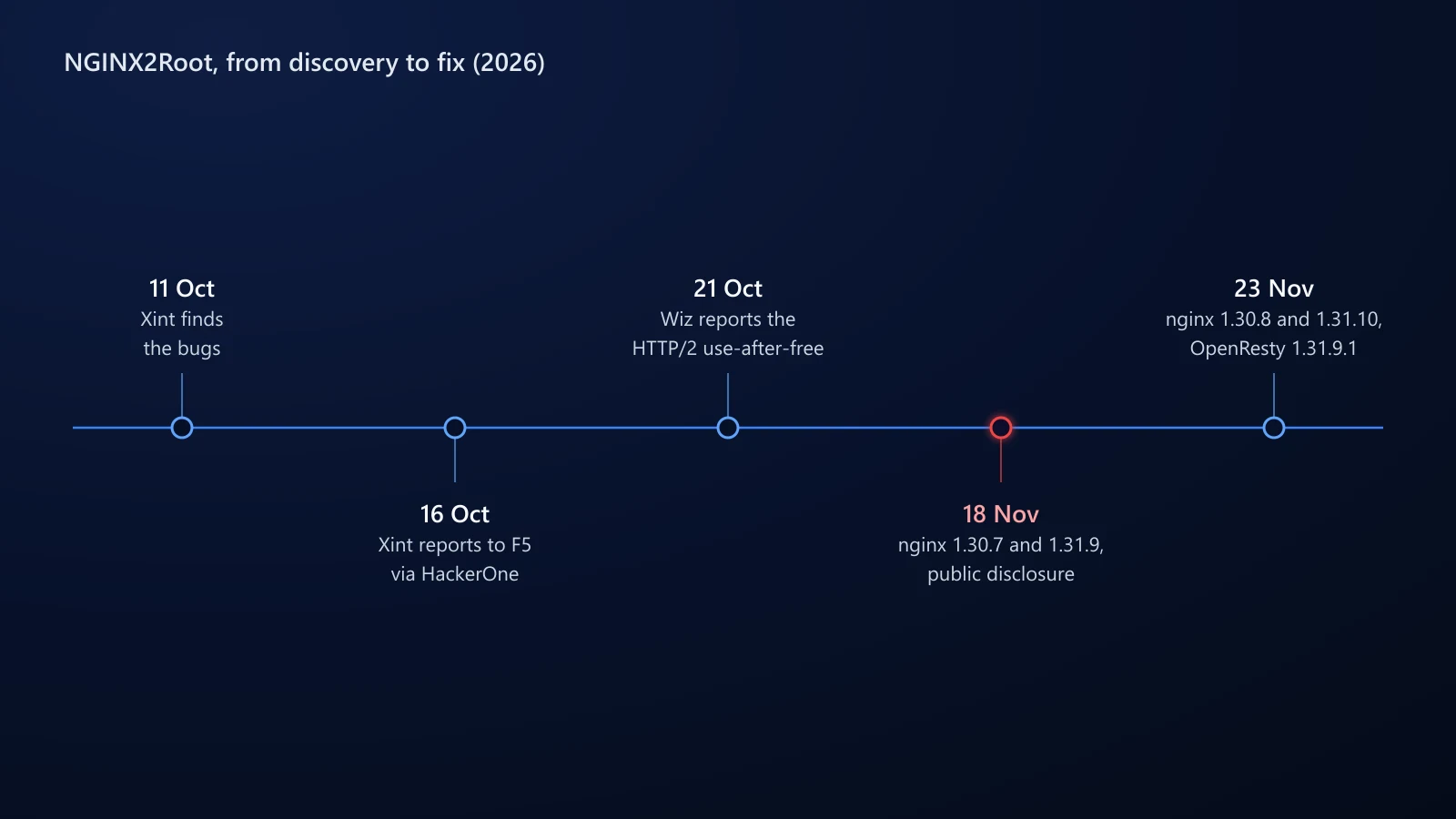
- 11 and 16 October. Xint finds the vulnerabilities, then reports them to F5, which maintains nginx, through HackerOne (nginx2root.com, Xint).
- 21 October. Wiz reports the HTTP/2 use-after-free (CVE-2026-123633), and F5 replies that another team had already reported it. Metnir says it reported that bug to F5 on 12 September (Precursor Security). Wiz, Ikotas Labs, Metnir, Rapid7 and Xint all found bugs in the set independently (Wiz).
- 18 November. nginx releases 1.30.7 (stable) and 1.31.9 (mainline) with ten security fixes (nginx.org). CERT-EU publishes Security Advisory 2026-022 the same day.
- 23 November. nginx releases 1.30.8 and 1.31.10 with one more fix, CVE-2026-132779, excessive CPU usage when
ssl_early_datais on with TLS 1.3, which affects 1.21.4 to 1.31.9. It is a denial of service, not a code execution flaw, but it means the versions to aim for are now 1.30.8 and 1.31.10, not 1.30.7 and 1.31.9. OpenResty ships 1.31.9.1 the same day.
Am I vulnerable? The five NGINX2Root flaws and the configs they need
The five critical flaws are separate doors, each opened by a different part of the configuration. F5 rates all five 9.2 under CVSS 4.0, according to Tenable, and CERT-EU gives each a score of 8.1, the CVSS 3.1 score that Ubuntu and Red Hat also publish.
| CVE | What it is | Exposed if | Affected versions | Does turning HTTP/2 off help? |
|---|---|---|---|---|
| CVE-2026-123007 | Memory corruption in HTTP/2 flow control | HTTP/2 is enabled, even on a server that only serves static files | 1.9.5 to 1.31.8 | Yes |
| CVE-2026-123633 | Use-after-free in HTTP/2 | HTTP/2 is enabled and nginx forwards requests to a backend (reverse proxy) | 1.19.7 to 1.31.8 | Yes |
| CVE-2026-121810 | Use-after-free in HTTP/3 | HTTP/3 (QUIC) is enabled and nginx forwards requests to a backend | 1.25.0 to 1.31.8 | No |
| CVE-2026-123634 | Use-after-free in the DNS resolver | A resolver is set, proxy_pass is built from the request, and mirror is used with mirror_request_body off | 0.6.18 to 1.31.8 | No |
| CVE-2026-113425 | Use-after-free in the mail proxy | The mail proxy runs with proxy on and auth_http, no valid credentials required | 0.5.33 to 1.31.8 | No |
Conditions are from Xint, version ranges from the nginx advisories (Xint gives slightly different first affected versions for the resolver and mail flaws). The same release fixed five less severe issues, from an infinite loop with TLS 1.3 request bodies (CVE-2026-118899) to a client certificate bypass with SNI in the stream module (CVE-2026-120967).
In practice, most public nginx servers fall under the first row. nginx does not turn HTTP/2 on by default, but it is a common addition to HTTPS setups, on the listen line (listen 443 ssl http2;) or with http2 on;. Censys counted about nine million nginx services running an affected version with HTTP/2 enabled on 18 November, a figure that may include distribution builds already carrying the fix (Tenable).
On a server you control, this command shows the directives that matter for each row of the table:
nginx -T 2>/dev/null | grep -nE 'http2|quic|http3|resolver|mirror|auth_http|^\s*mail'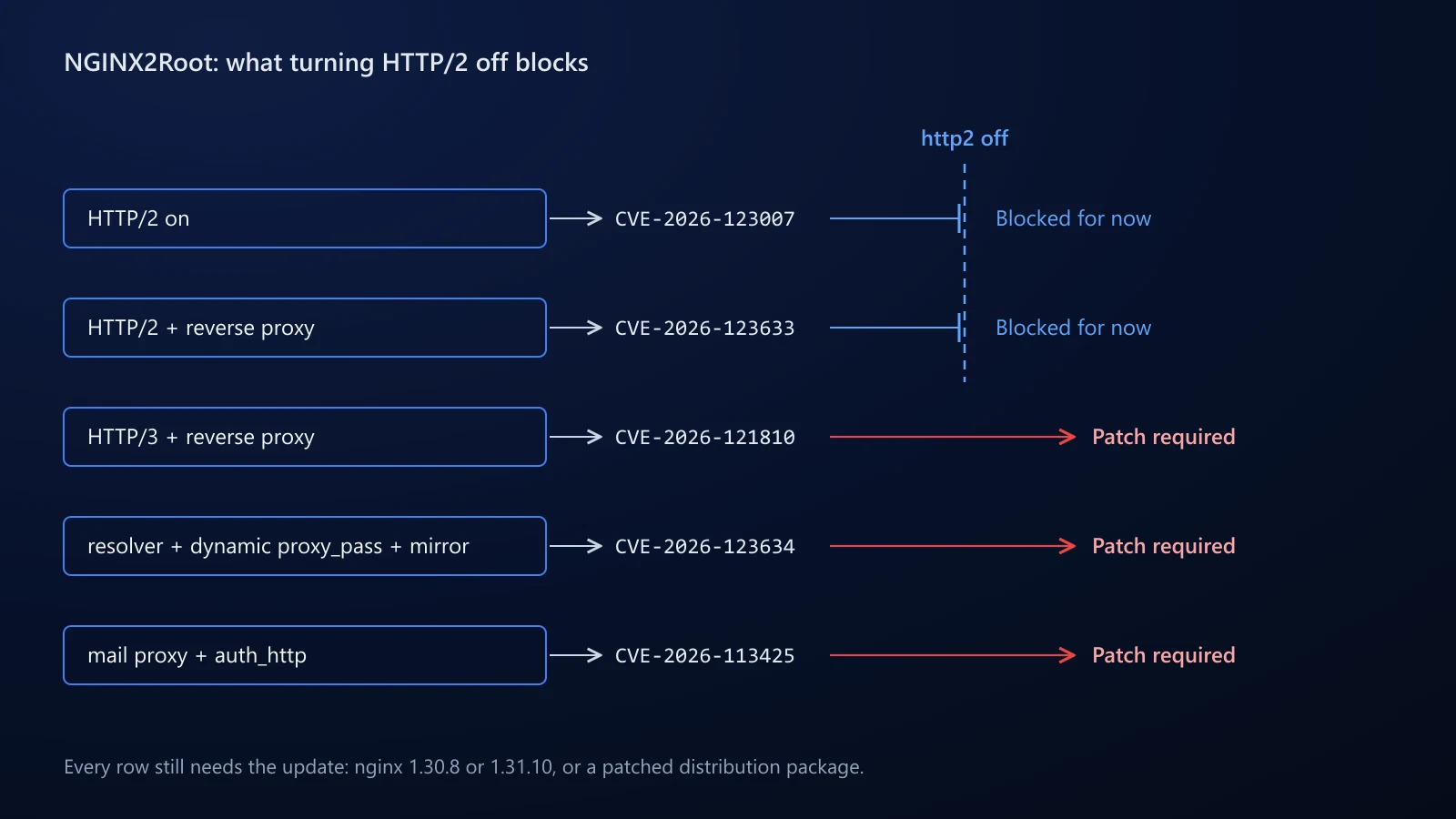
Fixed nginx versions: 1.30.8 and 1.31.10
| Branch | Affected | Fixes the five RCE flaws | Version to run today |
|---|---|---|---|
| Mainline 1.31 | 1.31.8 and older | 1.31.9 | 1.31.10 |
| Stable 1.30 | 1.30.6 and older | 1.30.7 | 1.30.8 |
| 1.29 and older | Every release from 1.9.5 for CVE-2026-123007 | No upstream release | Move to 1.30.8, or a patched distribution package |
| NGINX Plus 37.x | 37.0.0 to 37.0.7.1, 37.1.0 to 37.2.0.1 | 37.0.8.1 and 37.3.0.1 | The latest 37.x |
| NGINX Plus R34 to R36 | Affected | No fix | Move to 37.x |
Sources: nginx.org, CERT-EU, Tenable. A simple reload is not enough: Xint notes that the update needs a restart, or a supported live binary upgrade, so the old workers really exit.
Distribution packages and other builds
Most servers do not run nginx straight from nginx.org. They run a distribution package, a container image, or a product that embeds nginx. Distributions backport the fix into the version they already ship, so nginx -v can keep saying 1.18.0 on a patched Ubuntu 22.04 server. Compare the full package version with your distribution's or vendor's advisory, not the nginx version.
| Build | Status | Fixed package or version |
|---|---|---|
| Debian 12 bookworm | Fixed, DLA-4918-1 | 1.22.1-9+deb12u11 |
| Debian 13 trixie | Fixed, DSA-6642-1 | 1.26.3-3+deb13u11 |
| Ubuntu 26.10 | Fixed, USN-9159-1 | 1.30.4-7ubuntu1.2 |
| Ubuntu 26.04 LTS | Fixed | 1.28.3-2ubuntu1.13 |
| Ubuntu 24.04 LTS | Fixed | 1.24.0-2ubuntu7.20 |
| Ubuntu 22.04 LTS | Fixed | 1.18.0-6ubuntu14.23 |
| Ubuntu 20.04, 18.04, 16.04 | Fixed with Ubuntu Pro (16.04: Legacy Support add-on) | 1.18.0-0ubuntu1.7+esm5 on 20.04, 1.14.0-0ubuntu1.11+esm6 on 18.04, 1.10.3-0ubuntu0.16.04.5+esm11 on 16.04 |
| Red Hat Enterprise Linux | Rated Critical, see RHSB-2026-019 | Check the errata for your release |
| Official Docker image | Fixed on 18 November (Cycode) | nginx:1.31.9, nginx:1.30.7 and later tags, stable, mainline, latest (run docker pull again) |
| Alpine 3.24 and edge | Fixed on 18 November (Cycode) | nginx 1.30.7-r0 or later. Alpine 3.22 and 3.23 had no fix yet on 18 November |
| OpenResty | Fixed | 1.31.9.1, 23 November 2026 |
| Kubernetes ingress-nginx | Retired in March 2026, no upstream fix | See below |
Images you build on top of nginx need a rebuild, and so do appliances and products that bundle nginx: check each vendor's advisory. On 18 November, Metnir reproduced the bug in OpenResty and reported crashes in the shipped builds of Kong, Apache APISIX and NGINX Gateway Fabric, which all turn HTTP/2 on by default, according to Precursor Security. Treat any nginx-based gateway as affected until its vendor says otherwise.
Kubernetes ingress-nginx. The community controller was retired in March 2026: no more releases, no more security fixes. It enables HTTP/2 by default (use-http2: "true"), so a default install is exposed. HeroDevs says its paid extended-support build fixes CVE-2026-123007 (HeroDevs). Otherwise, set use-http2: "false" in the controller ConfigMap as a stopgap and plan the move to a maintained controller or the Gateway API. F5's own NGINX Ingress Controller is a different product with its own advisory.
Is NGINX2Root exploited? Real and fake exploits
The headlines mix three different situations, and it helps to keep them apart.
- Working exploits exist, mostly unpublished. Wiz confirmed code execution, with ASLR (the address randomisation that normally makes memory bugs hard to use) defeated, against official nginx 1.31.7 and 1.31.8 builds, and is not releasing its exploits for now (Wiz). Xint demonstrated it over a public IP on AWS, GCP and Azure (Xint), and its demo videos leave out the final steps (Tenable).
- One genuine public proof of concept. Rapid7 published a trigger script and an RCE demonstration for CVE-2026-123007. Its author says it only suits a freshly started local Docker container, and will likely fail against a server with several clients or a worker that has run for a while, behind a proxy that alters HTTP/2 frames, or without enough bandwidth.
- Fake exploits are circulating on GitHub. Cloudflare and Precursor Security both warn about repositories that claim to exploit NGINX2Root (Cloudflare, Precursor Security). Fake exploits for famous CVEs are a classic way to infect the machines of the people who run them. Do not run an exploit from an unknown repository, and do not use one to "test" production.
As of 24 November, no exploitation in the wild had been reported (StepSecurity), and as of the CISA update of 27 November, none of the five CVEs was in the Known Exploited Vulnerabilities catalog (CISA). Exploitation still takes effort and varies by version and build, which buys time. It does not make a patch optional.
What to do now
- Find every nginx you run. Public sites, staging, reverse proxies in front of applications, Kubernetes ingress controllers, Docker images, appliances. Check the
Serverheader of each public domain and subdomain (see below), and runnginx -v(or your package manager) on each server. - Patch. Update to 1.30.8 or 1.31.10, or to your distribution's fixed package, or rebuild your images on a patched base. Restart nginx.
- If you cannot patch today, turn HTTP/2 off. See below. It covers CVE-2026-123007 and CVE-2026-123633 only. For the others, Xint suggests turning off HTTP/3 and QUIC listeners, replacing request-time DNS lookups with fixed upstreams, and binding mail listeners to loopback or restricting who can reach them.
- Check that your CDN really shields you. Cloudflare explains that proxied hostnames are protected against the HTTP/2 and HTTP/3 flaws because the attacker's frames end at its edge and never reach your nginx. The resolver flaw depends on how
proxy_passis built, the mail flaw is not covered, and none of this holds if your origin is reachable directly. Cloudflare also says WAF rules are not relevant here, since these are protocol bugs. The same logic applies to any CDN or load balancer that terminates HTTP/2. - Watch for signs of attempts. CERT-EU suggests monitoring the error log for
worker process ... exited on signal, which may point to attempts but is not proof of compromise, and checking process creation logs, for example for processes started by the nginx workers.
Turning off HTTP/2, and what it costs
CERT-EU gives two ways: set http2 off; (the http2 directive exists since nginx 1.25.1), or remove the http2 parameter from the listen lines. Do it in every server block that listens on the same address and port:
server {
    listen 443 ssl;      # was: listen 443 ssl http2;
    http2 off;           # nginx 1.25.1 and later
    ...
}
Then restart (a reload can leave old workers running) and check, from outside, that HTTP/2 is gone (this prints 1.1 instead of 2):
curl -sI --http2 -o /dev/null -w '%{http_version}\n' https://www.example.comThe cost is real but usually bearable. Browsers fall back to HTTP/1.1, so the site keeps working, possibly a little slower. What breaks is gRPC, which needs HTTP/2: Xint warns that services that require HTTP/2, "such as native gRPC, will be affected" (Xint). Treat it as a stopgap for a few days, and turn HTTP/2 back on once you have patched.
How to check which nginx version a site runs
By default, nginx announces itself in every response, in the Server header:
curl -sI https://www.example.com | grep -i '^server'
# Server: nginx/1.31.8
The Technology Checker detects nginx, and shows its version only when the Server header exposes it; the curl line above shows the exact banner. For a broader look at how to identify the technologies a site uses, see What technology is this website using.
Read the result with two caveats. A distribution package says nginx/1.18.0 even when it carries the fix, so an old number from the outside means "check the package", not "vulnerable". And a bare Server: nginx means server_tokens off is set.
Why server_tokens off is not a patch
server_tokens off removes the version from the Server header and error pages. It is good hygiene (see Information disclosure headers), and the Security Header Scanner flags banners that give versions away. But it changes nothing in the code that handles HTTP/2. An attacker does not need to read your version to send a malicious HTTP/2 connection: they can simply try it on every nginx they find. Hiding the version also hides it from you and your auditors, so keep your own inventory of what each server runs.
Stay ahead of the next one
After PHP2Shell, Brotli2Shell and Java4Shell, NGINX2Root is one more case this autumn of teams having to answer "where do we run X?" in a hurry. A client-side script inventory does not detect a server RCE like this one: what helps is knowing where you run nginx. The 2Shell list keeps every named critical bug of 2026 and its fixed versions in one place.
If you also use nginx to set your Content Security Policy, our guide to per-request CSP nonces in nginx shows how to do it on a static site.
FAQ
What is NGINX2Root?
NGINX2Root is the name Xint gave to five critical nginx vulnerabilities disclosed on 18 November 2026, led by CVE-2026-123007 in HTTP/2, plus a Linux kernel flaw that turns access as the nginx worker into root on the host. It is not an official nginx or F5 name.
Is nginx 1.31.9 safe, or do I need 1.31.10?
1.31.9 and 1.30.7 fix the five NGINX2Root flaws. 1.31.10 and 1.30.8, released on 23 November, also fix CVE-2026-132779, excessive CPU usage with ssl_early_data. Run 1.31.10 or 1.30.8.
Is my server vulnerable if HTTP/2 is off?
Not to CVE-2026-123007 and CVE-2026-123633, which need HTTP/2. It can still be exposed to the other three if it uses HTTP/3 behind a reverse proxy, the resolver with a request-built proxy_pass and mirror, or the mail proxy. Patch anyway.
My Ubuntu server says nginx 1.18.0. Is it vulnerable?
The version alone does not tell you. Ubuntu backports fixes into 1.18.0, so look at the package version: on Ubuntu 22.04, 1.18.0-6ubuntu14.23 or later is fixed. Run dpkg -l nginx and compare with the Ubuntu CVE page.
Is NGINX2Root being exploited?
No exploitation in the wild was reported as of 24 November 2026, and none of the CVEs was in the CISA KEV catalog. Researchers have working exploits, Rapid7 published a limited proof of concept, and fake exploits circulate on GitHub. Assume attacks will come and patch now.
How do I check if my nginx is vulnerable?
On the server, run nginx -v and compare with the fixed versions; if nginx comes from your distribution, compare the package version with its advisory instead. Then run nginx -T to see whether HTTP/2, HTTP/3, the resolver or the mail proxy are on. From the outside, the Server header gives a first hint, not a verdict.
Is Kubernetes ingress-nginx affected?
Yes, by default: it enables HTTP/2 and was retired in March 2026, so there is no upstream fix. Set use-http2: "false" as a stopgap and move to a maintained controller. See ingress-nginx.
Does hiding the nginx version with server_tokens off protect me?
No. It hides the version string, not the vulnerable code. See Why server_tokens off is not a patch.
Am I safe behind Cloudflare or another CDN?
Largely, for the HTTP/2 and HTTP/3 flaws, if the connection ends at the CDN and your origin cannot be reached directly. Not reliably for the resolver flaw, and not for the mail flaw. Patch the origin anyway.
Related
- The 2Shell vulnerabilities of 2026, from React2Shell to Ruby2Shell
- PHP2Shell, CVE-2026-109618 and CVE-2026-109619 PHP RCE
- Brotli2Shell, CVE-2026-111497 Brotli decoder RCE
- What technology is this website using, and is any of it outdated
- Java4Shell, CVE-2026-114938 OpenJDK Base64 RCE
- Magecart and formjacking: how to detect a skimmer
- How to add a fresh CSP nonce to a static site with nginx
Sources
- nginx, news (releases of 14 October, 18 November and 23 November 2026)
- nginx, security advisories
- nginx, server_tokens directive
- nginx, http2 directive
- Xint, NGINX2Root: new remote code execution vulnerabilities in nginx
- Xint, nginx2root.com
- Wiz, Unauthenticated remote code execution in NGINX: CVE-2026-123633 and CVE-2026-123007
- CERT-EU, Security Advisory 2026-022, Critical vulnerabilities in Nginx
- Ubuntu, CVE-2026-123007
- Debian security tracker, CVE-2026-123007
- Red Hat, CVE-2026-123007
- CISA, Known Exploited Vulnerabilities catalog
- OpenResty, changelog for 1.31.9.1
- Cloudflare, nginx2root and how Cloudflare protects origins
- Rapid7 (Stephen Fewer), CVE-2026-123007 proof of concept
- Tenable, NGINX2Root FAQ
- Cycode, NGINX2Root status by distribution
- Precursor Security, NGINX2Root live updates
- StepSecurity, nginx2root (CVE-2026-123007)
- Kubernetes, Ingress NGINX retirement
- HeroDevs, nginx2root and Ingress NGINX
- CSO Online, AI unearths internet-breaker flaws in nginx web server