Java4Shell, CVE-2026-114938 OpenJDK Base64 RCE

CentralCSP Team
CentralCSP ·
Last update:
On 17 November 2026, Oracle and the OpenJDK project fixed CVE-2026-114938, nicknamed Java4Shell: a memory bug in the part of the Java runtime that decodes Base64 text. Base64 is everywhere on the web (login tokens, cookies, API payloads), and a malformed Base64 string sent by a visitor can make the server write past the end of a memory buffer. Calif's Quang Luong, who found it, turned that into remote code execution (taking control of the server), without logging in, against default configurations of Jira, Confluence, Jenkins, Keycloak, JFrog Artifactory and PingFederate.
It only bites when several conditions line up: a recent Java version, a recent Intel or AMD processor with a specific instruction set, and an application that decodes Base64 from untrusted input. Many recent servers and cloud instances meet the first two, and login, CI and collaboration tools often meet the third. In an alert the Canadian Cyber Centre contributed to, CISA urged organisations to patch immediately.
The short answer, depending on what you run:
- Java 17 (from 17.0.6), 21, 25 or 27: update to a build that carries the fix, 17.0.21.1, 21.0.13.1, 25.0.5.1 or 27.0.1.1 for Oracle builds, or your vendor's equivalent. Then restart the Java processes.
- Standard Java 8 or Java 11, or Java 17.0.0 to 17.0.5: not affected by this CVE. Builds that old lack years of other security fixes, so update anyway.
- Oracle Java SE 8 Enterprise Performance Pack: update to 8u513-perf.
- Products that ship their own Java (installers, container images, appliances): apply the vendor's update or replace the bundled runtime. Updating the server's Java does not fix a copy inside the product.
- Cannot patch today: start Java with
-XX:-UseBASE64Intrinsicsuntil you can.
So the first question is not "which version?" but "where do we run Java?". This post covers what Java4Shell is, who is exposed, the fixed builds, how to check your servers and what to do now, with no exploitation details.
What is Java4Shell, CVE-2026-114938
Base64 turns binary data into plain letters and digits so it can travel inside text: HTTP headers, JSON, cookies, single sign-on tokens. Java decodes it with the standard java.util.Base64 class, used by a great many Java applications and libraries.
To go faster, the Java virtual machine (JVM, the program that runs Java code) swaps some common routines for hand-written processor instructions, called intrinsics. On x86-64 processors with the AVX-512 VBMI instruction set, the Base64 decoder has such a shortcut. According to Calif's write-up, that shortcut mishandles the last few characters of some malformed inputs and writes past the end of its output buffer. Java then rejects the input with an error, but the memory next to the buffer may already be corrupted. Calif says this can reveal memory contents or lead to remote code execution.
| CVE | CVE-2026-114938 |
| Nickname | Java4Shell, a nod to Log4Shell. If you searched for "Java2Shell", this is the same story |
| Component | Base64 decoder intrinsic of the x86-64 HotSpot JVM, in OpenJDK and every Java distribution built from it |
| Type | Out-of-bounds heap write, from a crash to remote code execution |
| Severity | 8.1 (High) under CVSS 3.1 as rated by Oracle, which notes a high attack complexity; 9.2 (Critical) under CVSS 4.0 as rated by Calif |
| Credited to | Quang Luong (Calif) and the OpenJDK contributor albertnetymk, who found the root cause in September after a public crash report (see the timeline) |
| Affected | OpenJDK 17.0.6 and later, 21, 25 and 27, on x86-64 with AVX-512 VBMI |
| Not affected | Standard Java 8 and 11, Java 17.0.0 to 17.0.5, ARM64 processors |
| Fixed | 17.0.21.1, 21.0.13.1, 25.0.5.1, 27.0.1.1 (Oracle numbering), 17 November 2026 |
The name recalls Log4Shell in December 2021, with one difference that matters for the fix. Log4Shell was a library you found in your dependencies and upgraded. Java4Shell is in the runtime itself, so a scan of your application's dependencies does not show it: you need to know which Java runtimes run where, including the ones products bring along.
Who is exposed
Four conditions have to hold at the same time.
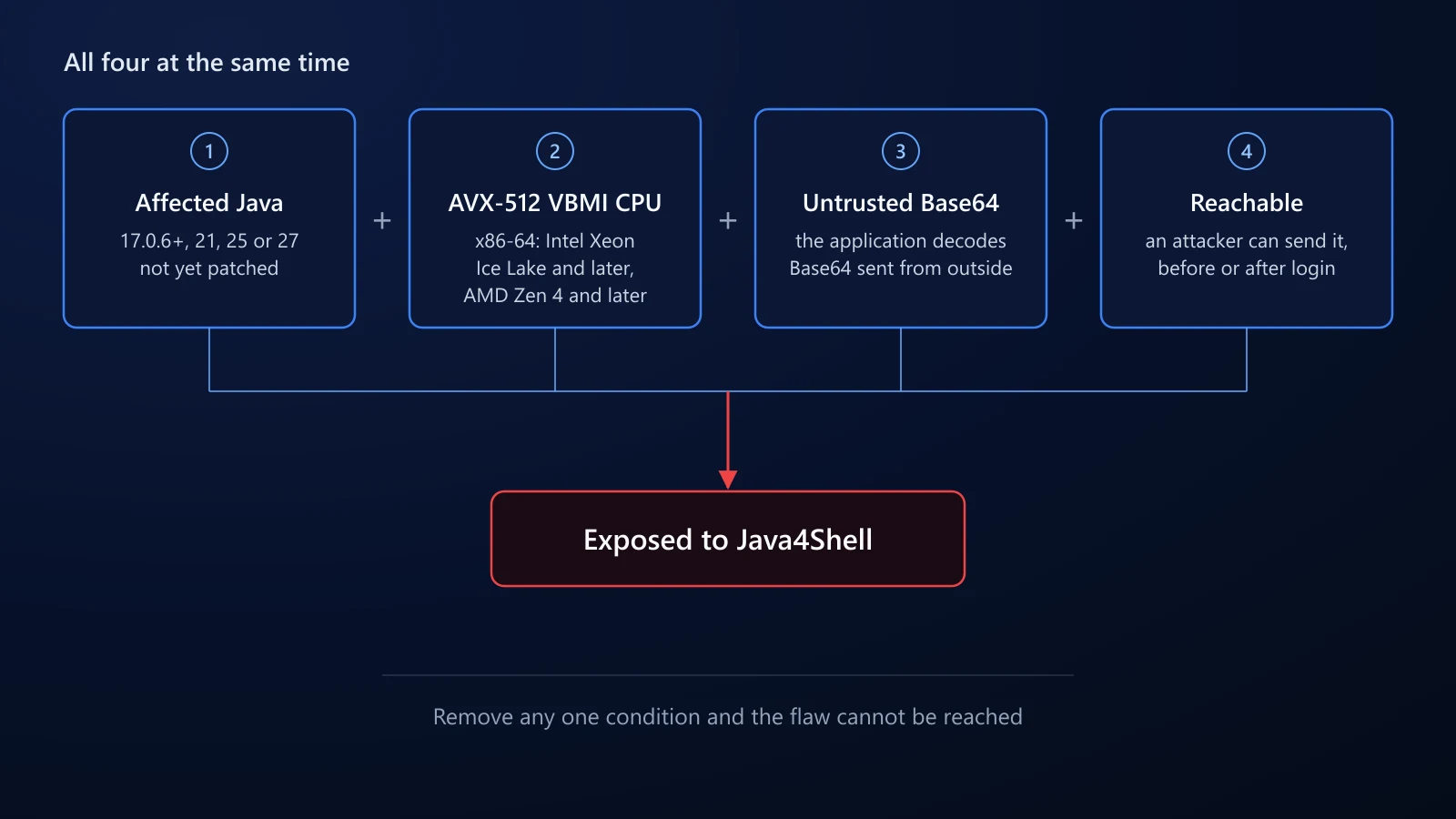
1. An affected Java version. Java 17 from 17.0.6, and Java 21, 25 and 27 up to the November fix. The OpenJDK advisory lists the 17, 21, 25 and 27 lines; standard Java 8 and 11 are not listed (Tenable). Every distribution built from OpenJDK carries the same code: Oracle Java SE, Oracle GraalVM for JDK, Eclipse Temurin, Amazon Corretto, Microsoft Build of OpenJDK, Azul Zulu, BellSoft Liberica, SAP SapMachine and Red Hat OpenJDK (Calif).
2. A processor with AVX-512 VBMI. The vulnerable shortcut only runs on x86-64 processors that support it. Calif gives Intel Xeon from Ice Lake onwards (Ice Lake, Sapphire Rapids, Emerald Rapids, Granite Rapids) and AMD EPYC and Ryzen from Zen 4 onwards as examples. That covers a large share of recent servers and cloud instances. ARM64 machines, such as AWS Graviton or Apple silicon, are not affected, and Red Hat reports no known exposure on x86-64 without AVX-512 VBMI (Rapid7).
3. Base64 decoding of untrusted input. According to Oracle, exploitation requires an application to pass untrusted data to the affected Java APIs, for example through a web service (Tenable, watchTowr). That is common: login headers, tokens and API fields are often decoded before anyone checks who sent them.
4. Reachability. Calif showed remote code execution in default configurations of these products (Calif):
| Before login (pre-auth) | After login (post-auth) |
|---|---|
| Keycloak | Apache Kafka broker |
| Atlassian Jira | Apache Solr |
| Atlassian Confluence | Elasticsearch |
| JFrog Artifactory | Gerrit |
| Jenkins | Spinnaker |
| PingFederate |
Calif says the list is not exhaustive, and it also reached code execution in sample Apache Struts and Spring Boot applications. Stacking the conditions, OX Security estimates that out of 10,000 Java instances, about 2,200 run the vulnerable code on affected hardware, 80 could be crashed remotely without logging in, and 12 are realistic targets for remote code execution. A small share, but they are exactly the internet-facing login, CI and collaboration servers attackers want.
How Java4Shell unfolded
The bug was visible in public for months before it got a CVE.
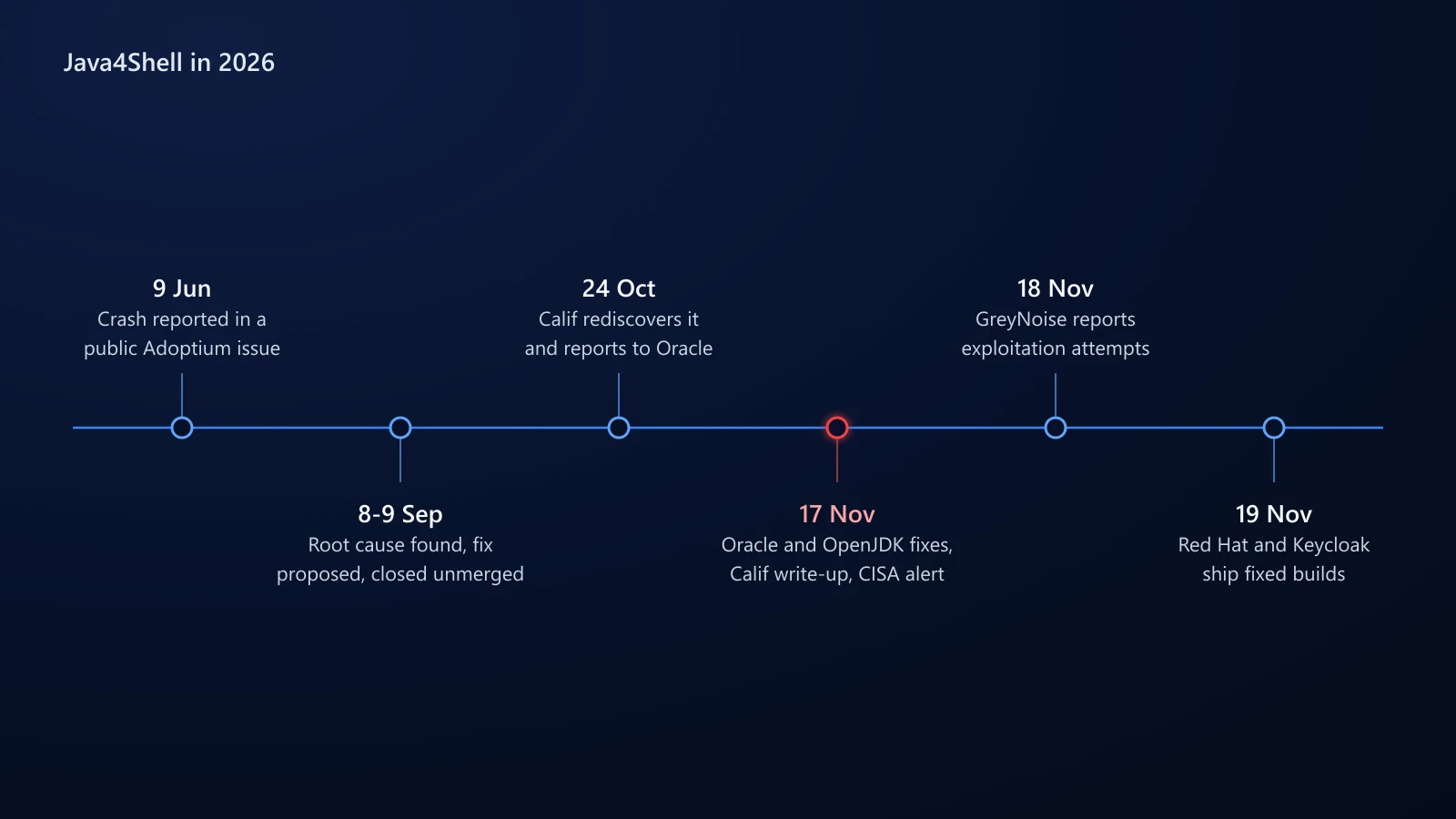
- 9 June. An OpenJDK user hits the crash and opens a public issue with Eclipse Adoptium, the Temurin project (Calif).
- 8 and 9 September. A reproducer is posted, the root cause is identified, and a fix is proposed to OpenJDK (pull request 32781). It is later closed without being merged.
- 24 October. Quang Luong of Calif finds the bug independently with the help of an AI coding agent and reports it to Oracle, with a working exploit against Elasticsearch (after logging in). Calif says finding the bug took an hour and the first working exploit two more.
- 17 November. Oracle publishes its scheduled November Critical Security Patch Update, which includes the fix, OpenJDK publishes its advisory (the fix is JDK-8393212, per oss-security), and Calif publishes its write-up with a reproducer that only checks whether a JDK and processor combination is affected. CISA and the Canadian Cyber Centre (AL26-029) issue alerts the same day (CISA).
- 18 November. GreyNoise reports exploitation attempts and has not confirmed any successful exploitation against its sensors. Ubuntu ships fixed packages, and Keycloak recommends the JVM flag workaround (Tenable).
- 19 November. Red Hat ships fixed OpenJDK packages for RHEL, and Keycloak updates its 26.8 container images. A post on the oss-security mailing list notes that Chainguard rediscovered the same issue independently through fuzzing.
- 24 November. Rapid7 reproduces command execution on Elasticsearch 7.17.28 and 7.17.29 with Java 17 and 21 in its lab, and stresses that this does not show the exploit works reliably in general (Rapid7).
Is Java4Shell being exploited in the wild?
Not confirmed so far. The vendor and researcher updates we checked (up to 24 November) report no successful exploitation in the wild, and CVE-2026-114938 is not in CISA's Known Exploited Vulnerabilities catalog (version of 27 November 2026). Attempts did start fast: GreyNoise reported them by 18 November. VulnCheck says it has a working exploit for its customers, Immersive's Kevin Breen reports building one, and Calif is holding back its own; none is public. VulnCheck expects narrow, application-specific paths rather than one universal exploit (Tenable). That slows attackers down without stopping them, so patch now rather than wait for the first confirmed attack.
Which Java versions are affected, and the fixed JDK builds
The fixed builds add a number to the latest release of each line: 17.0.21 became 17.0.21.1. Anything at or above the fixed build in its line carries the fix.
| Product | Affected | Fixed in |
|---|---|---|
| Oracle Java SE 17 | 17.0.6 to 17.0.21.0.3 | 17.0.21.1 |
| Oracle Java SE 21 | Up to 21.0.13.0.3 | 21.0.13.1 |
| Oracle Java SE 25 | Up to 25.0.5.0.3 | 25.0.5.1 |
| Oracle Java SE 27 | Up to 27.0.1.0.3 | 27.0.1.1 |
| Oracle Java SE 8 Enterprise Performance Pack | 8u511b33-perf | 8u513-perf |
| Oracle GraalVM for JDK 17 and 21 | 17.0.21.0.3, 21.0.13.0.3 | 17.0.21.1, 21.0.13.1 |
| Oracle GraalVM Enterprise Edition | 21.3.20.0.3 | 21.3.20.1, according to Rapid7 and the Cyber Centre (watchTowr still listed it as not yet available) |
| Eclipse Temurin 17, 21, 25, 27 | Builds before the fix | 17.0.21.1, 21.0.13.1, 25.0.5.1, 27.0.1.1 |
Debian 12, openjdk-17 | 17.0.19 package | 17.0.21.1+2-1~deb12u1 (DLA-4917-1) |
Debian 13, openjdk-21 | 21.0.13 package | 21.0.13.1+2-1~deb13u1 (DSA-6639-1) |
Debian 13, openjdk-25 | 25.0.5 package | 25.0.5.1+2-1~deb13u1 (DSA-6640-1) |
| Keycloak container images | 26.8.2-1, 26.8.2-2 | 26.8.2-3 (tags latest, 26.8, 26.8.2), with Red Hat OpenJDK 21.0.13.1 |
| Amazon Corretto, Azul Zulu, Microsoft Build of OpenJDK, Ubuntu, RHEL | Affected lines 17, 21, 25, 27 | Fixed builds released, check the vendor's version |
According to Help Net Security, earlier builds than those Oracle lists are likely affected too. Sources: Rapid7 and watchTowr for the Oracle table, Tenable for Temurin, Keycloak and the other vendors, and the Debian security tracker. Upwind notes that the older JDK-8321599 fix (17.0.11, 21.0.3), sometimes quoted as the answer, does not cover this bug (Upwind).
Jira, Jenkins, Keycloak: products that bring their own Java
Many Java products ship their own runtime inside the installer, the container image or the appliance, and CISA warns that these runtimes may not show up as separate entries in software inventories. For them, apt upgrade on the host changes nothing: the product keeps using its own copy until its vendor ships an update, or until you point it at a fixed runtime where the vendor supports that. Check each vendor's advisory for Atlassian Data Center products, Jenkins installs and images, Keycloak, Artifactory, PingFederate, Elasticsearch, Kafka and Solr, and for developer tools and security appliances that embed Java.
Am I vulnerable to Java4Shell?
Start with the inventory, then narrow down with three checks on each machine or container image.
Where do we run Java? List the servers, containers and appliances that run a JVM, and the products on them. On Linux, these show the runtimes the package manager knows about and the Java processes running right now:
java -version                         # default runtime on the PATH
ls /usr/lib/jvm/                      # runtimes installed by the package manager
ps -eo pid,args | grep '[j]ava'       # running Java processes and their full path
The full path in ps is the useful part: it shows a product running its own bundled runtime, such as /opt/atlassian/jira/jre/bin/java. Run <that path> -version to read the version of that copy. In containers, run the check inside each image, not only on the host.
Does the processor support AVX-512 VBMI? Calif gives the Linux check: the processor flags must include avx512f, avx512bw, avx512vbmi and bmi2.
grep -m1 '^flags' /proc/cpuinfo | tr ' ' '\n' | grep -E '^(avx512f|avx512bw|avx512vbmi|bmi2)$'All four flags in the output means the shortcut can run. Cloud instance types change processor between generations, so check each type you use.
Is the workaround already active? Ask the running process, not a new java command, since the service may start with different options. jcmd ships with the JDK:
jcmd <pid> VM.flags -all | grep -w -E 'UseBASE64Intrinsics|UseAVX'UseBASE64Intrinsics set to false means the vulnerable shortcut is off in that process.
A version outside the affected range, an ARM64 host, or a processor without AVX-512 VBMI rules the CVE out for that machine. An affected version on an AVX-512 VBMI processor, behind a service that decodes Base64 from requests, is exposed until patched.
Can I check a website for Java4Shell from the outside?
Not reliably. A web page does not announce the Java version behind it, and a Jira or Jenkins login page looks the same on a patched and an unpatched server. No outside scanner, ours included, can read your JVM build from a URL.
What the outside view is good for is finding what you forgot you expose: an old Jenkins on a forgotten subdomain, a Keycloak login page, a Confluence from a past project. Your DNS records, certificates and cloud console's list of public endpoints are the best starting point. For the code those pages send to browsers, the free Technology Checker lists the JavaScript libraries and frameworks a page loads, with versions and known CVEs, which is a separate question from the JVM. What technology is this website using compares the outside approaches.
What to do now: patch, restart or apply the workaround
Our recommendations, most urgent first:
- Find your Java. Internet-facing services first: identity providers (Keycloak, PingFederate), CI servers (Jenkins), collaboration tools (Jira, Confluence), artifact repositories, search and messaging clusters. Include container images and products that bundle a runtime.
- Patch and restart. Install 17.0.21.1, 21.0.13.1, 25.0.5.1, 27.0.1.1 or your vendor's equivalent, rebuild container images on a patched base image, and restart every Java process: a running JVM keeps the old code until it exits. For products with a bundled runtime, apply the vendor's update.
- Apply the workaround where you cannot patch today. Add
-XX:-UseBASE64Intrinsicsto the JVM options of the service (the product's JVM options file, or theJAVA_TOOL_OPTIONSenvironment variable) and restart it. Calif's alternative,-XX:UseAVX=2, turns off AVX-512 entirely; use it on x86-64 only, as Java on ARM refuses to start with it. Keycloak recommends the first flag as an interim mitigation. Both are stopgaps, not fixes. - Reduce exposure. CISA's compensating controls: limit unauthenticated access, enforce input-size limits, and restrict and validate Base64 input at the application boundary.
- Watch for crashes. Crashing a vulnerable JVM is much easier than taking control of it (OX Security), so a failed attempt can show up as a crash. Unexpected restarts,
hs_err_pidcrash files, child processes spawned by the Java service user and unusual outbound connections are worth an alert.
Keep an inventory before the next one
This autumn, the first question has been the same every time: PHP and the Brotli decoder in October, and now Java. The 2Shell vulnerabilities of 2026 puts the series side by side. Each time, the teams that answered "where do we run it?" in an hour patched first.
On the server side, the answer lives in your asset inventory and your vendors' advisories. A client-side script inventory does not detect a server RCE like Java4Shell: what helps is knowing where you run Java.
FAQ
What is Java4Shell?
Java4Shell is the nickname of CVE-2026-114938, a memory corruption bug in the Base64 decoder of the OpenJDK HotSpot JVM on x86-64 processors with AVX-512 VBMI. It was disclosed and fixed on 17 November 2026 and can lead to remote code execution in applications that decode Base64 from untrusted input.
Which Java version fixes CVE-2026-114938?
For Oracle builds: 17.0.21.1, 21.0.13.1, 25.0.5.1 and 27.0.1.1, and 8u513-perf for the Java SE 8 Enterprise Performance Pack. Eclipse Temurin uses the same numbers. Other distributions (Corretto, Zulu, Microsoft, Red Hat, Debian, Ubuntu) have shipped their own fixed builds; check the vendor's version string.
Are Java 8 and Java 11 vulnerable to Java4Shell?
Standard Java 8 and Java 11 are not listed as affected. The exception is Oracle's Java SE 8 Enterprise Performance Pack, which is affected up to 8u511b33-perf and fixed in 8u513-perf.
Am I vulnerable if my servers run on ARM?
No. The vulnerable code only runs on x86-64 processors with AVX-512 VBMI. ARM64 servers, such as AWS Graviton, are not affected by this CVE. Do not apply the -XX:UseAVX=2 workaround there: Java on ARM fails to start with it.
Does updating Jira, Confluence or Jenkins fix Java4Shell?
Only if the update ships a fixed Java runtime, or if the product runs on a system Java that you update separately. The flaw is in Java, not in the product. Check which runtime the product uses (the full path of the running java process tells you) and follow the vendor's advisory.
How do I mitigate Java4Shell without patching?
Start the Java process with -XX:-UseBASE64Intrinsics, which turns off the vulnerable shortcut, and restart it. On x86-64 only, -XX:UseAVX=2 also works. Both are stopgaps until you install a fixed build, and jcmd <pid> VM.flags -all confirms the flag is active in the running process.
Is Java4Shell related to Log4Shell?
Only by name. Log4Shell (CVE-2021-44228) was a flaw in the Log4j logging library, fixed by upgrading a dependency. Java4Shell is a memory bug in the Java runtime itself, fixed by updating the JDK or JRE and restarting. The 2Shell vulnerabilities of 2026 compares the two in more detail.
Related
- The 2Shell vulnerabilities of 2026, from React2Shell to Ruby2Shell
- PHP2Shell, CVE-2026-109618 and CVE-2026-109619 PHP RCE
- Brotli2Shell, CVE-2026-111497 Brotli decoder RCE
- NGINX2Root, CVE-2026-123007 nginx HTTP/2 RCE
- How to detect vulnerable JavaScript libraries on a live website
- What technology is this website using, and is any of it outdated
Sources
- Calif, Java4Shell: write once, RCE everywhere
- Oracle, Critical Security Patch Update, November 2026
- CISA, Critical Java vulnerability requires immediate patching (17 November 2026)
- oss-security, CVE-2026-114938 OpenJDK Base64 decoder memory corruption (19 November 2026)
- Tenable, Java4Shell (CVE-2026-114938) FAQ
- Rapid7, CVE-2026-114938 critical pre-authentication remote code execution in Java
- watchTowr, Java4Shell (CVE-2026-114938) FAQ
- Help Net Security, Java4Shell OpenJDK vulnerability (18 November 2026)
- Upwind, Java4Shell: what we know now and what comes next
- OX Security, Java4Shell: easy to crash, hard to exploit
- Debian security tracker, CVE-2026-114938
- CISA, Known Exploited Vulnerabilities catalog
- NVD, CVE-2021-44228 (Log4Shell)
- IETF, RFC 4648, the Base16, Base32 and Base64 data encodings
- Oracle, Java troubleshooting guide, environment variables and system properties