Drupal vulnerabilities in 2026: the install.php takeover and safe versions

CentralCSP Team
CentralCSP ·
Last update:
In November 2026, Drupal fixed a critical vulnerability, SA-CORE-2026-017 (CVE-2026-132165), that let anyone on the internet take over a site through its installer, the install.php page used once to set Drupal up. Attackers used it the next day. A week later, Drupal shipped a second fix, SA-CORE-2026-019 (CVE-2026-136716), because some sites were still exposed after the first one, and that gap was exploited too.
If your organisation runs a Drupal site, ask whoever maintains it one question: is it on 11.4.14, 11.3.23 or 10.6.23, and did they run update.php afterwards? The update alone is not enough this time.
The short answer, depending on what you run:
- Drupal 11.4, 11.3 or 10.6: update to 11.4.14, 11.3.23 or 10.6.23, then run
update.php(ordrush updatedb). - Drupal 11.2 or older, 10.5 or older, 8 or 9: no fix is coming. Block
/core/install.phpat the web server today and plan the upgrade. - Drupal Commerce shop: also update the Commerce Core module to 3.3.13 or 8.x-2.41, and check your orders.
- Still on Drupal 10: it reaches end of life on 9 December 2026. Plan the move to Drupal 11.
The rest of this page gives the details: how the installer flaws unfolded, the version to run on each branch, Commerce Core, every Drupal core advisory of 2026 and how to check which version a site runs. We update it as new advisories land.
What happened: the install.php takeover (SA-CORE-2026-017 and 019)
Every Drupal site ships with an installer at /core/install.php. On a finished site it should do nothing. The SA-CORE-2026-017 advisory says that under specific conditions an attacker can use it to try to reinstall Drupal on a live site, which can lead to site takeover or remote code execution (running their own code on your server). No account is needed.
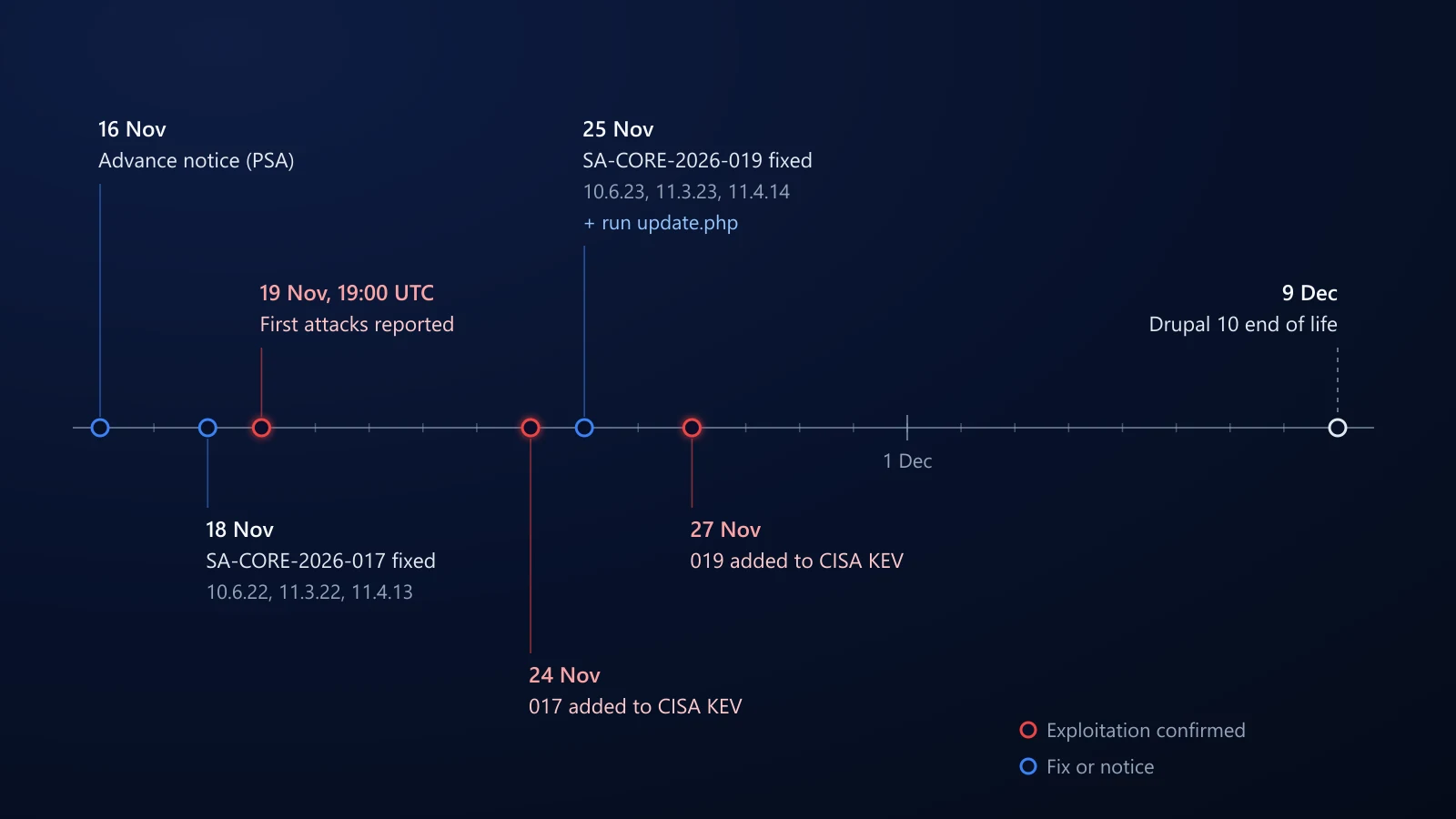
How it unfolded:
- 16 November. Drupal published an advance notice of a core security release for 18 November, rated Critical (18/25), warning that "exploits might be developed within hours or days".
- 18 November. Drupal released 10.6.22, 11.3.22 and 11.4.13 with SA-CORE-2026-017 (CVE-2026-132165). The advisory credits Anthropic's OSS Scanner with the discovery, and five people, including a member of the Drupal Security Team, with the report. The same releases fixed SA-CORE-2026-018, a moderately critical gadget chain: pieces of existing code an attacker can string together, but only with the help of another flaw, since it is not exploitable on its own.
- 19 November, 19:00 UTC. According to an update on the advisory, the flaw was exploited on live sites from that time. The advisory now rates it Highly critical, 20/25, with exploit code in the wild.
- 24 November. CISA added CVE-2026-132165 to its Known Exploited Vulnerabilities catalog, with a 27 November deadline for US federal agencies.
- 25 November. Drupal published SA-CORE-2026-019 (CVE-2026-136716), Highly critical, 21/25. The first fix closed several installer flaws, but sites left in "unusual or incomplete install states" stayed open to takeover, production sites included. Drupal says this one is being exploited in the wild. CISA added it on 27 November.
Why patching once was not enough
Two details make SA-CORE-2026-019 unusual. Drupal says the vulnerable state is not visible in the admin interface, so a site can look normal and still be exposed. And the fix is partly a database update: Drupal says an update hook must run to repair existing sites in that state. If you install the new code but never run update.php, the site can stay exposed.
The advisory adds a warning that is easy to miss: sites compromised earlier may no longer appear vulnerable. A site that updated on 18 November could have been taken over between the two releases.
Fixed Drupal versions: what to run on each branch
| Branch | Support status | First fix, SA-CORE-2026-017 | Version to run today |
|---|---|---|---|
| 11.4.x | Supported until 21 April 2027 | 11.4.13 | 11.4.14, then run update.php |
| 11.3.x | Security support ends the week of 7 December 2026 | 11.3.22 | 11.3.23, then run update.php |
| 10.6.x | Security support ends the week of 7 December 2026 | 10.6.22 | 10.6.23, then run update.php |
| 11.0 to 11.2, 10.5 and older | End of life | No release | Block install.php, upgrade to 11.4 |
| 8 and 9 | End of life | No release | Block install.php, upgrade |
Affected ranges, from the advisories: SA-CORE-2026-019 affects Drupal below 10.6.23, 11.0.0 to 11.3.22 and 11.4.0 to 11.4.13. The 16 November notice also lists the pre-releases 12.0.0-beta3 and 11.5.0-beta1 as affected by the first flaw. Drupal 7, which reached end of life on 5 January 2025, is not listed in either advisory.
Am I vulnerable?
- Your installer is already blocked at the web server: SA-CORE-2026-019 says sites that secured the installer are not vulnerable to it. Update anyway.
- You run a version below the "version to run today" column: your site is exposed. Update, run
update.php, and check for traces. - You updated, but not to the 25 November releases, or never ran
update.php: you may still be exposed to SA-CORE-2026-019. - You run an end-of-life branch: there is no fixed release for you. Blocking the installer is your only protection until you upgrade.
According to the advisories, sites behind Drupal Steward, Drupal's paid web application firewall service, are protected from the known attack paths. They should still upgrade.
How to fix it: update, run update.php, block install.php
-
Update Drupal core to 11.4.14, 11.3.23 or 10.6.23. On a Composer-managed site, that is usually:
composer update "drupal/core-*" --with-all-dependencies drush updatedb # same as visiting /update.php drush cache:rebuild -
Run
update.phpeven if no update looks pending. This is the step that repairs sites in the vulnerable install state. -
Block the installer on every site, new and existing. Drupal's guide to securing the installer recommends a web server rule. For nginx:
location ^~ /core/install.php {
  return 404;
}
For Apache, in the virtual host rather than
.htaccess:<Location "/core/install.php"> Require all denied </Location>Drupal's guide warns that the same rule in
.htaccesscauses a 500 error, and that Composer puts back a deletedinstall.phpand rewrites.htaccesson updates, so a server-level rule is the one that lasts. Check it with the three requests the guide gives:curl -I https://example.com/core/install.php curl -IL https://example.com/install.php curl -I https://example.com/core/install.php/fooAll three should end with a 403 or 404. A 200 means the block is not working.
-
Look for traces. SA-CORE-2026-019 asks you to check logs for unauthorized access, especially changes to or by user 1 (the first administrator account), to make sure user 1's email address is one you control, and to consider resetting its password. If you suspect a compromise, Drupal points to its guide "Your Drupal site got hacked. Now what?".
SA-CORE-2026-017 also notes that some attack paths fail when the web server cannot write to settings.php or change its permissions. Locking that file down is good practice, not a replacement for the update.
Drupal Commerce Core vulnerability (CVE-2026-118539), exploited in October
The other Drupal flaw attackers used this autumn was not in core. On 28 October 2026, Drupal published SA-CONTRIB-2026-254 for Commerce Core, the module that gives Drupal shops their cart, checkout and APIs.
| CVE | CVE-2026-118539 |
| Type | Access bypass: some routes and entity fields are not protected enough |
| Authentication | None, according to BleepingComputer |
| Risk | Highly critical, 21/25 |
| Affected | Commerce Core below 8.x-2.41, and 3.x before 3.3.13 |
| Fixed | 3.3.13 for the 3.x branch, 8.x-2.41 for older sites |
| Exploited | Yes, according to the advisory |
Drupal warns the flaw "may financially impact the vendor" and asks sites to audit their orders for inconsistencies. Citing the module's Drupal.org project page, BleepingComputer counts more than 42,000 sites using it. Commerce Core is a contributed module, so updating Drupal core does not fix it: update it on its own (composer update drupal/commerce --with-all-dependencies).
A shop also carries payment-page duties. PCI DSS 4.0.1 asks you to inventory and justify every script on payment pages (requirement 6.4.3) and to detect unauthorized changes to them and to their security headers (11.6.1). A server takeover is exactly when a new script can appear on a checkout page: that is how a Magecart card skimmer usually gets there. A script inventory built from CSP reports shows the script the day it starts running in shoppers' browsers, something a server update will not reveal.
Every Drupal core security advisory of 2026
Drupal core published 19 advisories in 2026. Three were exploited or targeted by exploit attempts in the wild, all of them Highly critical, and all three are in CISA's KEV catalog.
| Date | Advisory | Issue | Risk | Exploited |
|---|---|---|---|---|
| 15 April | SA-CORE-2026-001 to 003 | Two cross-site scripting (XSS) issues and a gadget chain | Critical (15/25) to moderately critical | No |
| 20 May | SA-CORE-2026-004 | SQL injection in the database API, PostgreSQL sites only. Fixed in 11.3.10, 11.2.12, 11.1.10, 10.6.9, 10.5.10 and 10.4.10 | Highly critical (23/25) | Yes, attempts detected from 22 May, CISA KEV the same day |
| 17 June | SA-CORE-2026-005 to 009 | PHP object injection through JSON:API, only with write access enabled and an unusual contributed or custom field type, plus a gadget chain, cache poisoning with open redirect, SSRF and improper validation | Critical (18/25) to less critical | No |
| 15 July | SA-CORE-2026-010 to 012 | Information disclosure and two XSS issues | Moderately critical | No |
| 16 September | SA-CORE-2026-013 | Third-party library updates | Moderately critical | No |
| 14 October | SA-CORE-2026-014 to 016 | Remote code execution in the Field UI module, reachable without an account through some contributed modules. Fixed in 11.4.10, 11.3.19, 10.6.19. Plus two XSS issues | Critical (19/25) to moderately critical | Not reported |
| 18 November | SA-CORE-2026-017, 018 | Installer takeover (above), and a gadget chain usable only with another flaw | Highly critical (20/25) and moderately critical (14/25) | Yes for 017, CISA KEV on 24 November |
| 25 November | SA-CORE-2026-019 | Installer access bypass that survived the first fix | Highly critical (21/25) | Yes, CISA KEV on 27 November |
The full list, with each CVE, is on Drupal's core security advisories page. Every release in the table also carries the fixes before it, so the November versions cover the whole year.
Drupal 10 end of life on 9 December 2026
Drupal's release schedule sets Drupal 10's end of life on 9 December 2026. Security support for 10.6.x, the last Drupal 10 line, and for 11.3.x ends the same week, when Drupal 12.0.0 and 11.5.0 are scheduled.
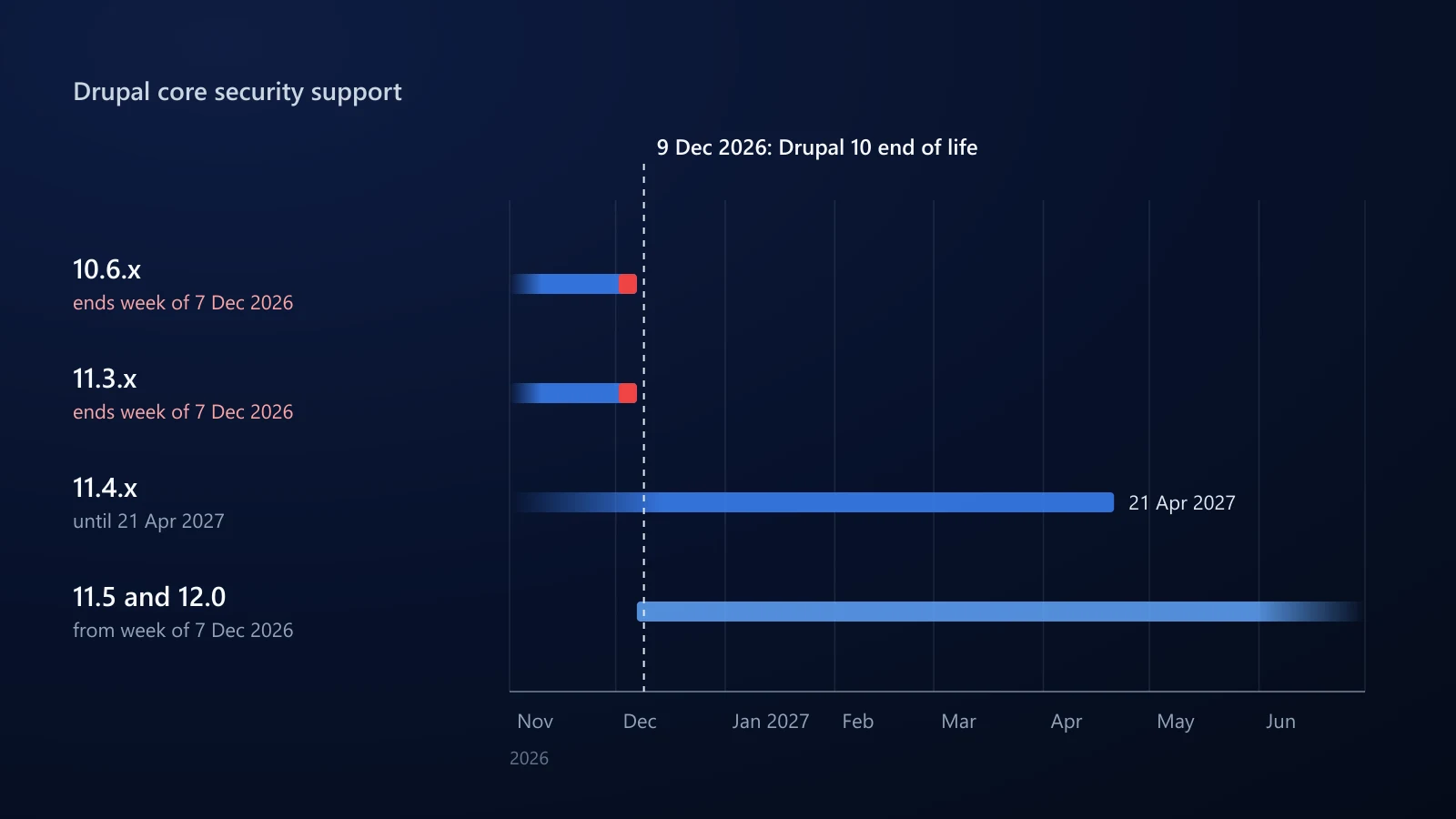
End of life does not switch a site off. It means that when the next advisory like SA-CORE-2026-019 comes out, there will be no Drupal 10 release to fix it. In November alone, a site on an end-of-life branch had no fixed version for two exploited flaws, and the only protection was a web server rule. Drupal 10.6.23 is the right version for a Drupal 10 site today, but it is one of the last, since no Drupal 10 release will follow end of life on 9 December 2026: the real fix is moving to Drupal 11.4 or later. Drupal 11 itself is scheduled for end of life in early December 2028.
How to check which Drupal version a site runs
On a site you administer, open Reports > Status report (/admin/reports/status), or on the server:
drush status          # shows the Drupal version
composer show drupal/core
From the outside, Drupal often announces itself in an X-Generator: Drupal 11 (https://www.drupal.org) header and a matching generator meta tag. Both give the major version only, which tells you the branch but not whether the site has the 25 November patch. Our page on headers that leak information covers what to remove.
The free Technology Checker gives you that outside view in one step. Enter a URL and it can show Drupal and its version when the page exposes it, with its lifecycle status and known CVEs, along with the JavaScript libraries the page loads, jQuery included. It lists PHP too when a header such as X-Powered-By gives it away.
If a site only exposes "Drupal 10", the checker tells you the branch is near end of life, not which patch is installed: the exact version, and whether update.php ran, come from the status report or Drush. The wider method is in What technology is this website using, and What a technology checker is for covers when an outside check is enough.
Get alerted when the next one lands
Drupal core shipped security releases in April, May, June, July, September, October and twice in November 2026, the same month as a string of named server flaws listed in our 2Shell overview. What matters is how quickly you hear about the next one.
A client-side script inventory does not detect a server flaw like the installer takeover: what helps is knowing which of your sites run Drupal, on which branch, and following Drupal's core security advisories.
FAQ
Which Drupal version fixes SA-CORE-2026-017 and SA-CORE-2026-019?
Drupal 11.4.14, 11.3.23 and 10.6.23, released on 25 November 2026, fix both, provided you run update.php after installing them. Older branches get no release: block /core/install.php at the web server and upgrade.
Is my site safe if I updated Drupal on 18 November?
Not necessarily. The 18 November releases (10.6.22, 11.3.22, 11.4.13) fixed SA-CORE-2026-017, but SA-CORE-2026-019 showed some sites stayed exposed. Update to 10.6.23, 11.3.23 or 11.4.14 and run update.php, then check user 1 and your logs, because a site taken over in between may no longer look vulnerable.
Why do I have to run update.php for SA-CORE-2026-019?
Because part of the fix is an update hook that repairs sites stuck in an unusual or incomplete install state. Installing the new code does not run it. Visit /update.php or run drush updatedb.
Does blocking install.php protect my Drupal site?
It closes the installer attack path, and SA-CORE-2026-019 says sites that secured the installer are not vulnerable to it. Use a web server rule, since Composer restores the file and .htaccess on updates. It does not fix other flaws, so update as well.
What happens when Drupal 10 reaches end of life?
From 9 December 2026, Drupal 10 gets no new releases, security fixes included. Sites keep working, but the next critical advisory will have no Drupal 10 fix. Run 10.6.23 now and plan the upgrade to Drupal 11.
Is Drupal 7 affected by SA-CORE-2026-017?
The advisories cover Drupal 10 and 11 and do not list Drupal 7. Drupal 7 reached end of life on 5 January 2025, so it receives no community fixes for anything. If you still run it, ask your extended support vendor.
How do I check which Drupal version a site runs?
On your own site, open the status report or run drush status. From outside, look at the X-Generator header or the generator meta tag, keeping in mind Drupal usually exposes only its major version. Only check sites you own or are authorized to assess.
Related
- The 2Shell vulnerabilities of 2026, from React2Shell to Ruby2Shell, every named critical bug of November
- WordPress vulnerabilities in 2026, and the version to run now
- PHP2Shell, CVE-2026-109618 and CVE-2026-109619 PHP RCE, the October PHP flaw that also concerned Drupal sites
- What technology is this website using, and is any of it outdated
- What a technology checker is for, from security ratings to PCI scans
- Build a script inventory with CSP hash reporting
- Magecart and formjacking: how to detect a skimmer, for Drupal Commerce checkouts
Sources
- Drupal.org, SA-CORE-2026-017, Remote code execution
- Drupal.org, SA-CORE-2026-019, Access bypass
- Drupal.org, SA-CORE-2026-018, Gadget chain
- Drupal.org, PSA-2026-11-16, upcoming critical core releases
- Drupal.org, Securing the installer (install.php)
- Drupal.org, Drupal core security advisories
- Drupal.org, SA-CORE-2026-004, SQL injection
- Drupal.org, SA-CORE-2026-005, PHP object injection
- Drupal.org, SA-CORE-2026-014, Remote code execution
- Drupal.org, SA-CONTRIB-2026-254, Commerce Core access bypass
- Drupal.org, Drupal core release schedule
- Drupal.org, Drupal 7 end of life
- CISA, Known Exploited Vulnerabilities catalog (CVE-2026-132165 added 24 November, CVE-2026-136716 added 27 November, CVE-2026-9082 added 22 May 2026)
- BleepingComputer, Drupal patches critical RCE flaw, warns exploits may surface quickly
- BleepingComputer, Drupal warns of critical Commerce Core flaw exploited in attacks